949–1022 · 10th century
Symeon the New Theologian and the Origins of Hesychast Theology
At 14 Symeon became a disciple of Symeon the Studite, then a monk of the Stoudios monastery. From 980 to 1005 he was abbot of the monastery of St. Mamas in Constantinople. A dispute with the court theologian Stephen of Nicomedia ended in his exile in 1009; Symeon was later restored to his rights and died in 1022. Most controversial was his claim that the mystical experience he taught about is available to all Christians.
He was called the "New Theologian", probably by analogy with Gregory the Theologian. He laid the foundations of a tradition that Gregory Palamas would systematize three centuries later in the hesychast disputes.
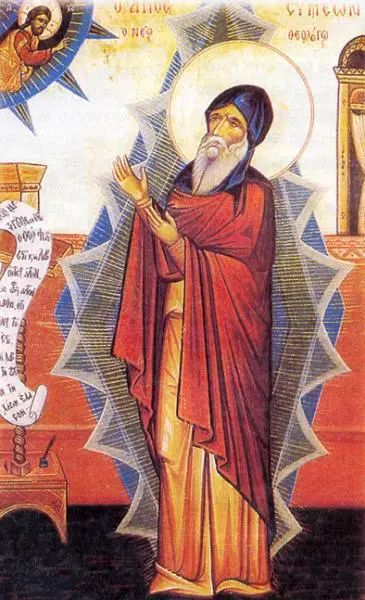
Key points
- Abbot of the monastery of St. Mamas (980–1005) and exile in 1009 after the dispute with Stephen of Nicomedia
- Most controversial claim: the mystical experience is available to all Christians
- The name "New Theologian" – probably by analogy with Gregory the Theologian
- The source of the hesychast tradition later continued by Gregory Palamas
- Avvakumov: Symeon the New Theologian, concerned with the person’s moral purity, tended to relativize the church’s established “objectified” sacramental order: he sharply criticized immoral priests and bishops and insisted on non-ordained monks’ right to hear confessions. Symeon proposed a “second baptism”, the baptism in tears, which unlike water baptism (“a type of the truth”) is “the truth itself”. His orthodoxy was suspected in his lifetime, and scholars still debate his proximity to heretical movements
People
- Symeon the New Theologian
- Symeon the Studite
- Stephen of Nicomedia
Place
Constantinople
Sources
- Tony Lane – Christian Thinkers (Russian edition), p. 82–84
- Justo L. González – A History of Christian Thought in One Volume (Abingdon, 2014), p. 234, 237
- Jaroslav Pelikan – The Christian Tradition, vol. 2: The Spirit of Eastern Christendom (600–1700) (Russian edition), p. 398–407
- The Oxford Handbook of Sacramental Theology, ed. Hans Boersma, Matthew Levering (2015), p. 314–315
Data compiled: 2026-11-09