1526–1530 · 16th century
The diets of Speyer and the Augsburg Confession
The first Diet of Speyer in 1526 effectively tolerated Lutheranism. But in February–April 1529 a second diet at Speyer voted to end that toleration. Six princes and fourteen cities protested in defence of freedom of conscience. Their protest gave rise to the word "Protestants".
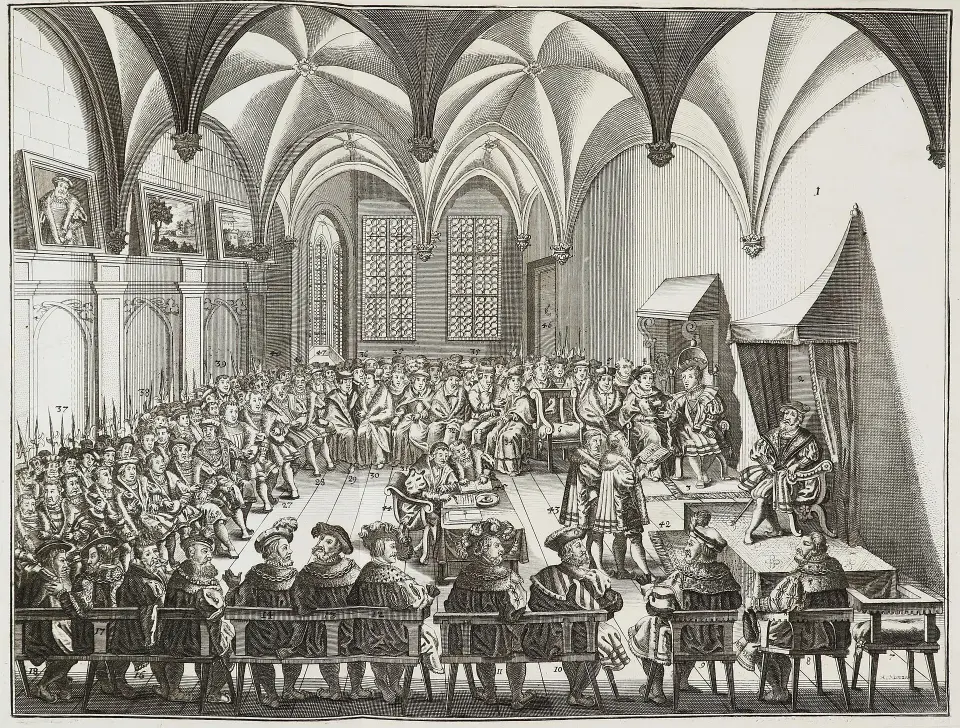
In 1530, at the Diet of Augsburg, Charles V demanded a statement of faith from the Protestants. Philip Melanchthon drafted the conciliatory Augsburg Confession: 21 articles plus 7 on abuses. It was read to the emperor in June. After its rejection Melanchthon wrote an "Apology".
The Augsburg Confession became Lutheranism's chief confessional document. However, a later revised edition (the "Variata") provoked disputes over its interpretation.
Key points
- The origin of the term "Protestants" (April 1529)
- Melanchthon's Augsburg Confession (June 1530)
- Justification by faith (art. 4) and real presence (art. 10: the Body and Blood of Christ "are truly present" in the Supper)
- A Greek translation of the Confession was sent to the Patriarch of Constantinople
- Kusukawa: at the Saxon elector’s request Wittenberg theologians drafted the confession; Melanchthon was the chief author. The German text was read on 25 June 1530; Strasbourg and others offered the Tetrapolitan Confession, Zwingli the Ratio fidei. The confession stressed secular order, condemned Anabaptists and set out justification, without directly attacking the mass or papal primacy. The Confutation was read on 2 August 1530; the Apology appeared in May 1531, with its text on the Supper changed
- Hazlett: Strasbourg theology – not a mere amalgam of Erasmian, Lutheran and Zwinglian ideas – found expression in the Tetrapolitan Confession (1530); Strasbourg affirmed solidarity with Wittenberg by subscribing to the Augsburg Confession in 1532
- Bagchi: the peak of Catholic polemic was the Confutation to Charles V at the Augsburg Diet (1530), a defense of tradition almost free of abuse; after 1525 Catholics blamed Luther both for radicalism and for reaction, using the Peasants’ War
- Mattox: the Catholic Confutation (1530) tepidly affirmed Lutheran teaching on the presence, but faulted Lutherans for abandoning concomitance.
People
- Philip Melanchthon
- Charles V
- Martin Luther
Place
Speyer; Augsburg
Sources
Primary sources
- Augsburg Confession, art. 4, 10
- Melanchthon – Apology of the Augsburg Confession, art. 10
Textbooks
- Alister McGrath – Reformation Thought (Russian edition: «Theological Thought of the Reformation»), p. 12–13, 165–167, 270, 341, 344, 353, 358, 378–379
- Justo L. González – A History of Christian Thought, vol. III: From the Protestant Reformation to the Twentieth Century (Abingdon, rev. ed. 1987), p. 108, 111–112, 114, 134
- Justo L. González – The Story of Christianity, vol. II (Russian edition), Part 1, ch. 4
- Tony Lane – Christian Thinkers (Russian edition), p. 162, 165–167
- Jaroslav Pelikan – The Christian Tradition, vol. 2: The Spirit of Eastern Christendom (600–1700) (Russian edition), p. 431–432
- The Cambridge Companion to Reformation Theology, ed. David Bagchi, David C. Steinmetz (2004), p. 74–75, 75, 112, 118, 232–233
- The Oxford Handbook of Sacramental Theology, ed. Hans Boersma, Matthew Levering (2015), p. 338–339
Data compiled: 2026-11-09