1816–1861 · 19th century
Slavery, schisms in American churches, and the rise of Black churches
Quakers (1776) and Methodists (1784) initially condemned slaveholding. Over time, however, southern Methodists and Baptists softened their stance, and in the South slavery was declared divinely ordained.
The slavery question split the largest Protestant denominations. In 1844 the Methodists divided into northern and southern branches. In 1845 the Baptists formed the Southern Baptist Convention, and in 1861 southern Presbyterians separated. Only Catholics and Episcopalians avoided schism.
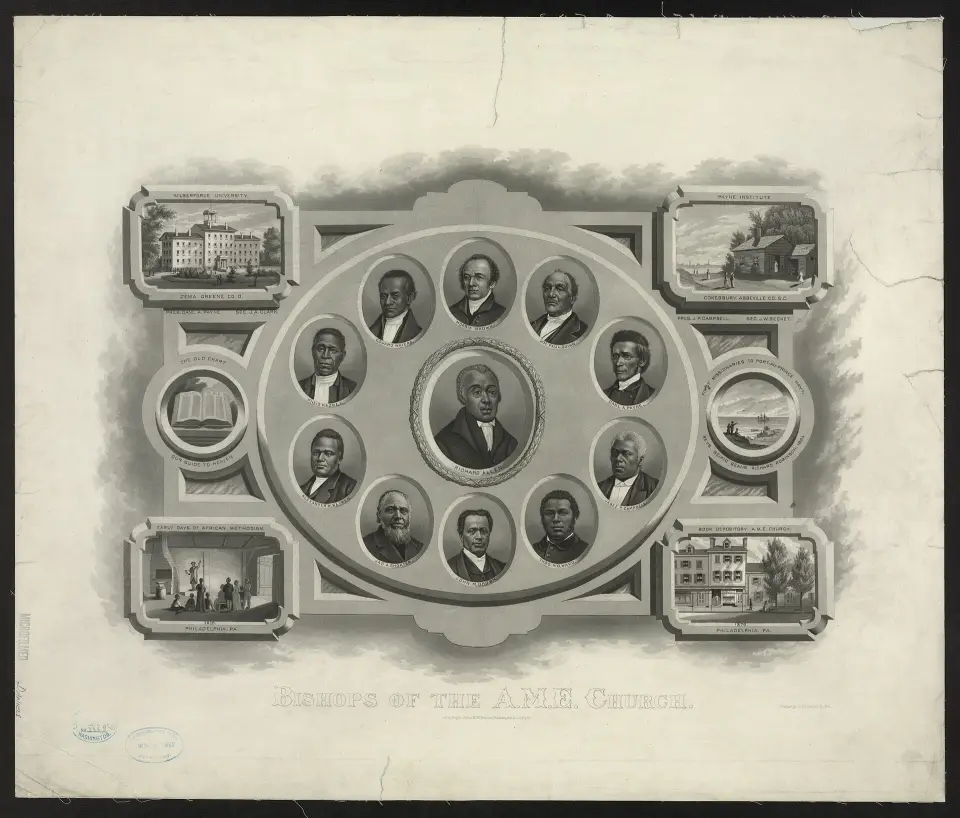
In parallel, the freedman Richard Allen founded the African Methodist Episcopal Church. In 1821 the African Methodist Episcopal Zion Church arose in New York. Black churches became the central institution of Black society and later helped lay the groundwork for the civil rights movement.
Key points
- The Methodist schism (1844) and the Baptist split forming the Southern Baptist Convention (1845)
- Southern Presbyterians' separation (1861)
- Only Catholics and Episcopalians avoided a schism
- Richard Allen's founding of the African Methodist Episcopal Church
- The African Methodist Episcopal Zion Church (1821, New York)
- Shelley: slavery in America began on 20 August 1619 at Jamestown; some masters forbade Bible teaching, others justified slavery from the New Testament. The Black preacher was a key figure in the slaves’ “invisible institution” church; Exodus themes were central. Voices defending slavery arose only in the 1830s: Southern clergy began defending it from the Bible (Furman, Lev 25:46), and the link of evangelical religion and race became a mark of the South in the “Cotton Kingdom” era. In the North the first evangelical to speak out against slavery was the travelling preacher Charles Finney; under his influence a resolute rejection of slavery took shape in the Middle West around Oberlin College (he was its president). Finney's disciple Theodore Weld wrote The Bible against Slavery (1837) and Slavery as It Is; in Uncle Tom's Cabin Harriet Beecher Stowe saw slavery as the guilt of the whole nation, not of the South alone. Lincoln, never a church member but shaped by the Bible, said in his second inaugural that both sides read one Bible and pray to one God, and concluded: “the Almighty has His own purposes”. Black churches grew into the main institution of freedom
- Billings: Lemuel Haynes (1753–1833), a Congregationalist pastor in Rutland, Vermont, was the first Black person ordained in the United States; in over 5,500 sermons he countered deists and Unitarians in New England and undercut pro-slavery arguments. Calvin erroneously assumed slavery no longer existed; in America it returned, was racialized and was defended with Scripture. In the age of lynching the Presbyterian Francis Grimké (1850–1937) proclaimed the immediacy and inevitability of divine judgment.
People
- Richard Allen
- Lemuel Haynes
- Francis Grimké
Place
United States
Sources
- Justo L. González – The Story of Christianity, vol. II (Russian edition), Part 3, ch. 25, section «Рабство и Гражданская война»
- J. North – A History of the Church (Russian edition), p. 14–15
- Bruce L. Shelley – Church History in Plain Language (Russian edition), Ch. 39, sec. «Христианство среди рабов»
- The New Cambridge Companion to Christian Doctrine, ed. Michael Allen (2023), p. 355, 356, 356–357
Data compiled: 2026-11-09