351–360 · 4th century
The Triumph of Homoian Arianism under Constantius II: the Councils of Sirmium and the "Dated Creed"
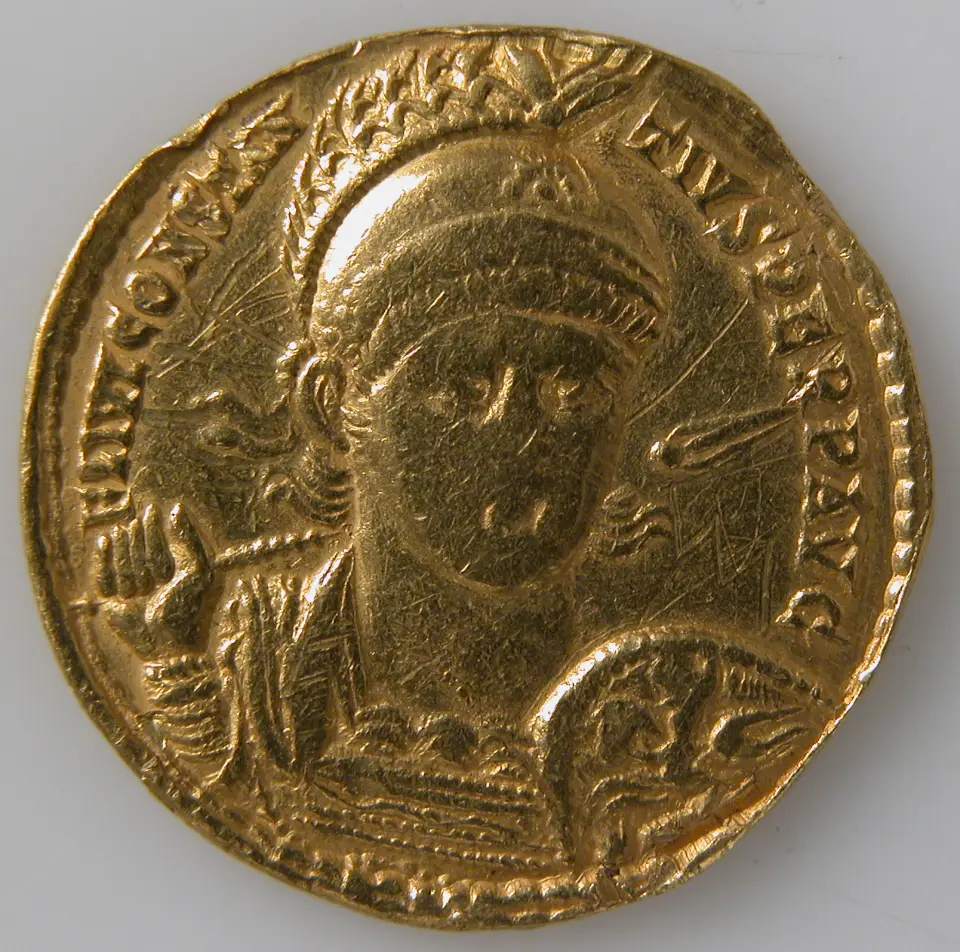
Having become sole ruler in the 350s, Constantius II openly adopted a pro-Arian policy: "My will is the church's canon". Athanasius was exiled, and troops surrounded the church where he was serving.
The councils of Sirmium (351, 357) worked out compromise formulas. In 357 a council banned the non-biblical words "substance", "of one substance" and "of like substance". It attributed the suffering on the Cross to the assumed humanity rather than the Godhead. The attempt failed, driving moderate semi-Arians toward the Nicenes.
The fourth Sirmian formula – the "Dated Creed" of May 22, 359 – avoided the word "substance" altogether, calling the Son merely "like the Father". It was imposed on western bishops at Ariminum and eastern bishops at Seleucia, both in 359. Its variant was adopted at Nike in Thrace. Even the aged Hosius of Cordoba and Pope Liberius signed Arian formulas.
In 360 Homoian doctrine became the empire's official confession for two decades. In Jerome's words, "the whole world groaned and marveled to find itself Arian".
Key points
- The Council of Sirmium (357) bans the terms "substance" and "of one substance"
- The "Sirmian Blasphemy": the signatures of Hosius of Cordoba and Pope Liberius
- The "Dated Creed" of 359 – the Son merely "like" the Father
- The councils of Ariminum (West) and Seleucia (East) in 359, and the creed of Nike in Thrace
- Homoianism as the empire's official confession from 360 for two decades
- Barnes: fourth-century Latins expressed Trinitarian unity as “one power”; Phoebadius read Sirmium’s 357 ban as forbidding talk of one power. Zeno, Lucifer, Niceta and Damasus speak of “one power,” “glory” and “majesty” of the Persons, often alongside “one substance”
People
- Constantius II
- Athanasius the Great
- Hosius of Córdoba
- Liberius of Rome
- Ursacius of Singidunum
- Valens of Mursa
- Germinius
- Eudoxius
- Macedonius of Constantinople
- Meletius of Antioch
- Jerome
- Phoebadius of Agen
Place
Sirmium, Ariminum, Seleucia, Nike in Thrace
Sources disagree
González dates the "Sirmian Blasphemy" to c. 355 ("five years after" 350), while the books on the Sirmium councils themselves give 351 and 357; the event spans several councils of the 350s.
Sources
- Justo L. González – The Story of Christianity, vol. I (Russian edition), Ch. 10, sec. 10.2; Ch. 12, sec. 12.2
- A. P. Lebedev – History of the Ecumenical Councils, part I, p. 43–44, 59–61, 74–75, 86, 96, 98, 114
- Louis Berkhof – History of Christian Doctrines (Russian edition), p. 60
- Stuart G. Hall – Doctrine and Practice in the Early Church (Russian edition), p. 97–98
- Justo L. González – A History of Christian Thought in One Volume (Abingdon, 2014), p. 122–123
- The Cambridge Companion to the Trinity, ed. Peter C. Phan (2011), p. 87–88, 87
More on the doctrine
- The anti-Nicene parties (Anomoeans, Homoeans, Homoiousians) and the reconciliation of 362–363 (355–363)
Data compiled: 2026-11-09