813–843 · 9th century
The Second Iconoclasm and the Triumph of Orthodoxy
Leo V the Armenian owed his throne to an iconoclast army. In 813–815 he revived the iconoclast dispute. He deposed Patriarch Nikephoros and in 815 convened a council that reaffirmed the iconoclast rulings of 754. A persecution of icon-venerators followed. Theodore the Studite suffered especially; he insisted that judgment on doctrine belonged to the church and not the emperor.
Michael II the Stammerer softened the persecution ("as I found the Church, so I leave it"). But his successor Theophilos (830–842) again cruelly persecuted icon-painters and monks.
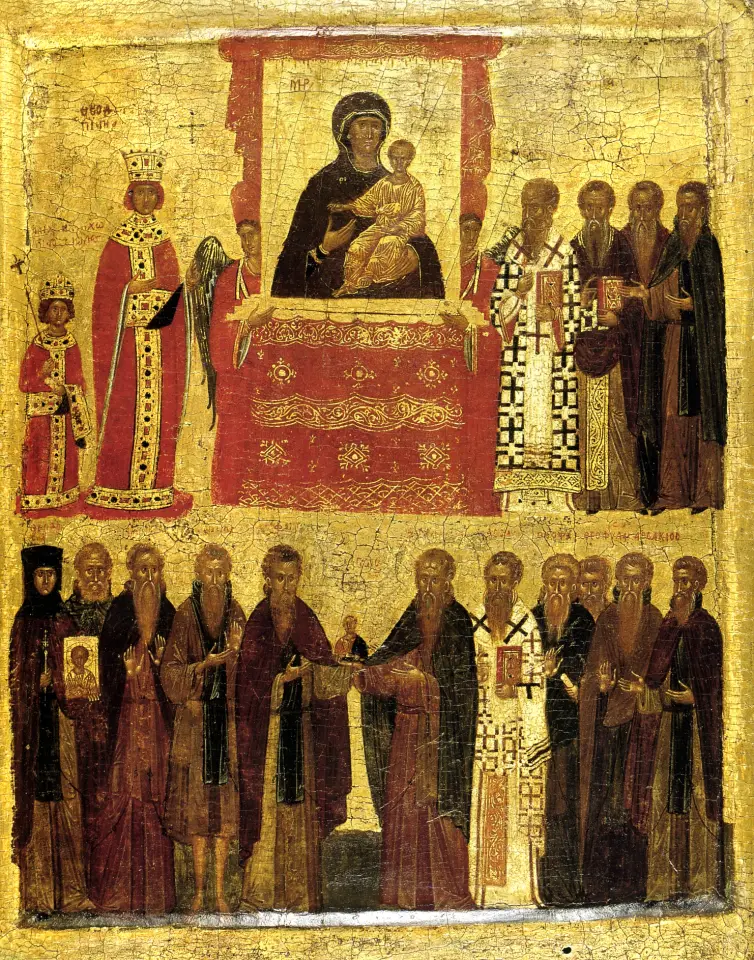
After Theophilos's death, the regent Empress Theodora, backed by Patriarch Methodios, restored icon veneration. A council in 842 reaffirmed the rulings of all seven ecumenical councils and anathematized the iconoclasts. On 19 February/11 March 843 the annual Feast of the Triumph of Orthodoxy was celebrated for the first time. It is still kept in the Eastern Church today.
Key points
- The deposition of Patriarch Nikephoros and the 815 council in Constantinople
- Emperor Theophilos's persecution (830–842) of icon-venerators
- Theodora's regency and the 842 council restoring icon veneration
- The first Feast of the Triumph of Orthodoxy (19 February/11 March 843) and the proclamation of the Synodikon
- Avvakumov: the end of iconoclasm (c. 726–843) divides late-antique from medieval Byzantium; afterward the “Byzantine rite” took shape. The Triumph of Orthodoxy (843) began the Synodikon with anathemas; Theodore’s Stoudios and Athos shaped the monastic line
People
- Leo V the Armenian
- Nikephoros of Constantinople
- Theodore the Studite
- Michael II
- Theophilos
- Theodora
- Methodios of Constantinople
Place
Constantinople
Sources disagree
Lebedev and Pelikan date the final Triumph of Orthodoxy to 19 February and 11 March 843 respectively; González gives 11 March 842 – the sources disagree on the exact date of the same event.
Sources
- J. North – A History of the Church (Russian edition), p. 161–162
- A. P. Lebedev – History of the Ecumenical Councils, part II, p. 186–203
- Justo L. González – A History of Christian Thought in One Volume (Abingdon, 2014), p. 231–232
- Jaroslav Pelikan – The Christian Tradition, vol. 2: The Spirit of Eastern Christendom (600–1700) (Russian edition), p. 216, 253, 264–265
- Tony Lane – Christian Thinkers (Russian edition), p. 80
- The Oxford Handbook of Sacramental Theology, ed. Hans Boersma, Matthew Levering (2015), p. 308
More on the doctrine
- The Iconoclastic Controversy: Christology, Tradition and the Seventh Ecumenical Council (787) (725–842)
Data compiled: 2026-11-09