818–855 · 9th century
Carolingian Theological Disputes: the Eucharist, Predestination, and John Scotus Eriugena
In the Frankish kingdom in the 9th century three theological disputes unfolded. In 818 Paschasius Radbertus advanced a new doctrine of the Eucharist; Rabanus Maurus and Ratramnus opposed him. At the same time the monk Gottschalk of Orbais put forward double predestination; he was condemned by the councils of Mainz (848–849) and Quierzy (853), while the council of Valence (855), by contrast, partly defended him.
The Irishman John Scotus Eriugena, head of Charles the Bald's palace school, took part in both disputes. His work "On the Division of Nature" was condemned as pantheistic in the early 13th century.
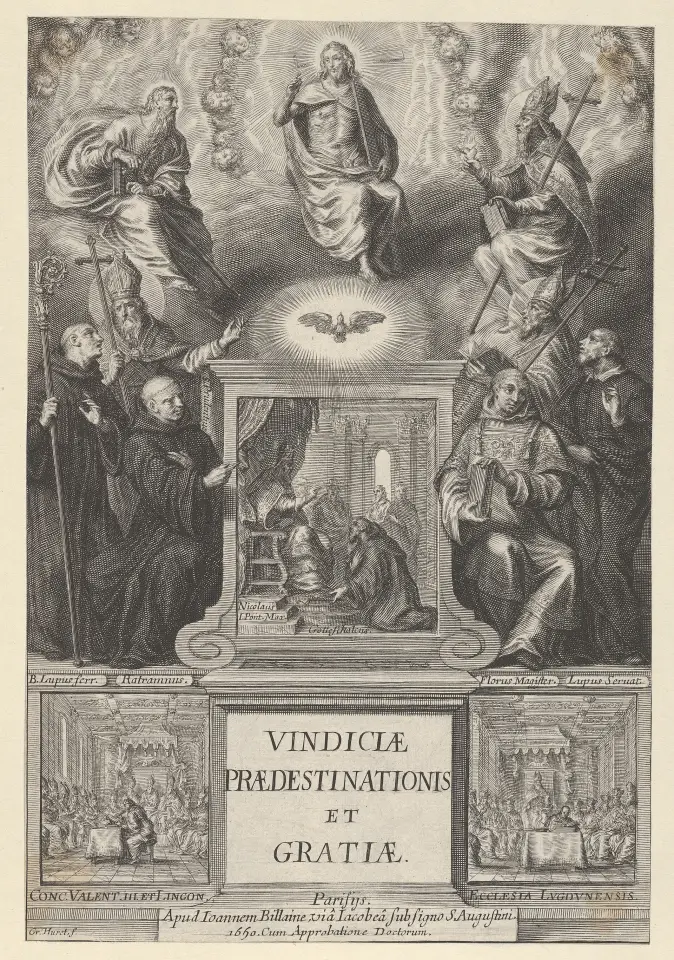
Key points
- Radbertus's advance (818) and the response of Rabanus Maurus and Ratramnus
- Gottschalk's dispute with Rabanus Maurus and Hincmar of Reims
- Gottschalk condemned at Mainz (848–849) and Quierzy (853), partly defended at Valence (855)
- Eriugena at the court of Charles the Bald; his work later condemned as pantheistic
People
- Paschasius Radbertus
- Rabanus Maurus
- Ratramnus of Corbie
- Gottschalk of Orbais
- Hincmar of Reims
- John Scotus Eriugena
- Charles the Bald
Place
the Frankish kingdom (Corbie, Mainz, Quierzy, Valence, Paris)
Sources
- Jaroslav Pelikan – The Christian Tradition, vol. 2: The Spirit of Eastern Christendom (600–1700) (Russian edition), p. 315, 324, 327
- Tony Lane – Christian Thinkers (Russian edition), p. 106–107, 121
- Louis Berkhof – History of Christian Doctrines (Russian edition), p. 101, 186
- Justo L. González – A History of Christian Thought in One Volume (Abingdon, 2014), p. 204–209
- Alister McGrath – Reformation Thought (Russian edition: «Theological Thought of the Reformation»), p. 190–191
More on the doctrine
- The eucharistic controversies of the 9th–11th centuries: Radbertus and Ratramnus, Berengar and Lanfranc (9th–11th centuries)
- The Gottschalk Controversy over Double Predestination (848–855)
Data compiled: 2026-11-09