1528–1560 · 16th century
The Scottish Reformation and John Knox
Protestant ideas had been reaching Scotland since the 1520s. It began with the martyrdom of Patrick Hamilton in 1528.
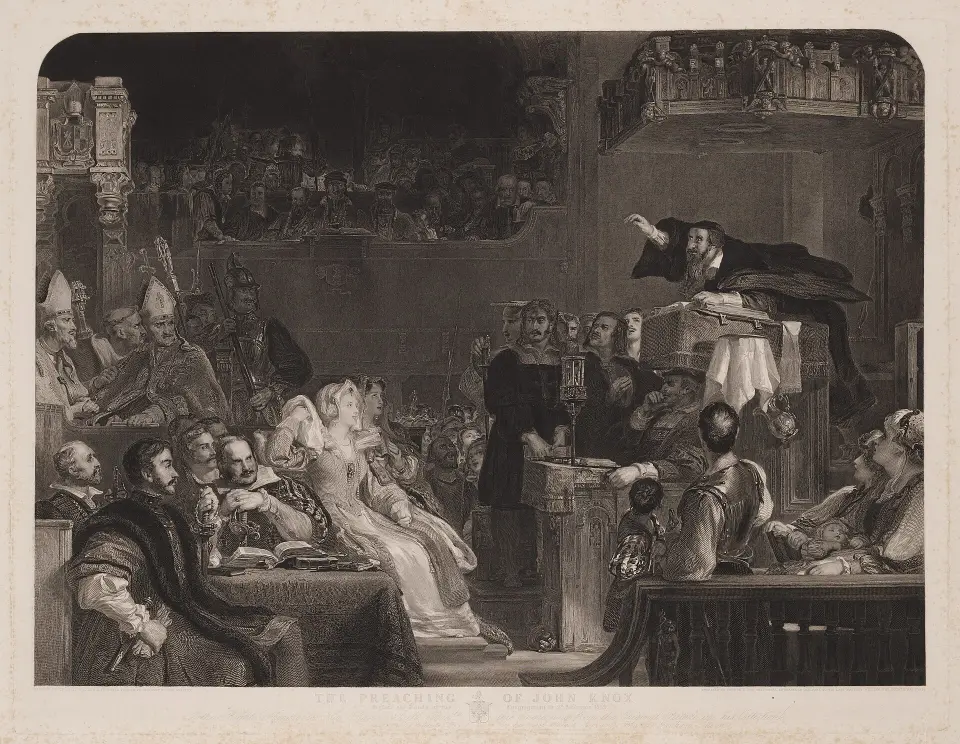
The preacher John Knox was converted under George Wishart's influence. He spent nineteen months as a galley slave on a French ship and then served at Edward VI's court. After that he lived with Calvin in Geneva and with Bullinger in Zurich.
In 1557 Protestant nobles formed the "Lords of the Congregation". In 1559 Knox returned to Scotland. With the help of English troops, in 1560 he secured the Treaty of Edinburgh and parliamentary adoption of the Protestant confession.
That August the "six Johns", including Knox, drafted the Scots Confession. This founded the Presbyterian Church of Scotland.
Key points
- The martyrdom of Patrick Hamilton (1528) – the first Scottish Protestant martyr
- The "Lords of the Congregation" (1557)
- The Treaty of Edinburgh (1560)
- The Scots Confession (August 1560), drafted by the "six Johns"
- Wright: the Scottish Reformation’s key documents – the Scots Confession and First Book of Discipline (1560) – were team efforts with no master reformer. The Forme of Prayers was composed by exiles at Frankfurt in 1555 and ordained by the Assembly in 1562, so calling it “Knox’s Liturgy” misleads. The Reformation leaned on foreign models: the Form of Prayers carried Calvin’s Geneva Catechism, then Craig’s catechism (1581); Wishart translated the First Helvetic Confession, the Assembly approved the Second Helvetic in 1566, but its influence stayed limited. Scottish reformers did not translate the Bible into Scots – English versions sufficed; the Geneva Bible was first published in Scotland in 1579. The first Gaelic printed book was Carswell’s Foirm na n-Urrnuidheadh, an adaptation of The Forme of Prayers (Edinburgh, 1567). Metrical psalms came from Geneva – the Forme of Prayers had 51 psalms (1556), 87 (1561) and all 150 (Scottish edition 1564); psalmody without human hymns and without instruments dominated Presbyterian worship until the nineteenth century. Scottish evangelicalism had Lollard roots: the 1494 trial of the “Lollards of Kyle” touched priesthood of believers, images and transubstantiation; Nisbet’s Scots New Testament rests on a Wycliffite manuscript but adds Lutheran-minded prefaces drawn from Coverdale. Patrick Hamilton, burned in 1528, was the protomartyr of the Reformation; his Places set out Lutheran law and gospel. Gau published at Malmö (1533) the first substantial Lutheran treatise in Scots; the vernacular New Testament was briefly permitted in 1543. Sir John Borthwick was charged with heresy in 1540, fled to England and was condemned in absentia; the sentence was annulled in 1562. Balnaves wrote in a Rouen prison in 1548 a treatise on justification (after Luther), the weightiest Scottish Protestant work to that date. Wishart led preaching tours in 1544–5 and was burned in 1546; at trial he stood nearer Zwingli than the First Helvetic Confession. Knox answered that rites not commanded by God in “plain words” are not of faith and sinful; his first sermon struck at the root of the papacy. He spent about twelve years outside Scotland; his chief theological work then was the defense of predestination (Geneva, 1560). The First Blast attacked female rule, and the Appellation (1558) called nobles and people to take reform into their own hands. Christopher Goodman (1519–1603), Knox’s ally at Frankfurt and Geneva, served in Scotland from 1559 and shaped the Forme of Prayers and Geneva Bible; in his 1558 work he argued for rightful overthrow of tyrants more radically than Knox and influenced the notion of the covenanted nation. The Scots Confession was written by Knox and five other “Johns”, so calling it “Knox’s Confession” is customary but imprecise; Winram and Maitland softened expressions and cut the right of resistance to rulers, and per Shaw, Willock may have written the moderate election article. The Reformation’s theological literature appears only two or three decades after 1560. John Craig wrote the Negative or “King's” Confession of 1581 and had a part in the Second Book of Discipline (1578); Robert Pont translated the Second Helvetic Confession and wrote a Latin verse catechism of 1573; other authors include Patrick Adamson and John Davidson (Some Helpes for Young Schollers in Christianity, 1602). The Heidelberg Catechism was published in Edinburgh in Latin in 1591 and in English in 1615. Andrew Melville, chief architect of the Second Book of Discipline, lectured on Romans at St Andrews from 1580 (published 1850) and in Scholastica diatriba (1599) argued that Scripture be studied in the original languages. Robert Rollock (c. 1555–99), first principal of Edinburgh University, promoted covenant theology. John Erskine of Dun, who received Wishart in 1543, became superintendent of Angus and wrote tracts on grace and union with Christ. Ferguson (1563) and Hay (1563) defended the view of the mass as idolatry; Abbot Kennedy declined public debate. The Scots Confession (1560) was drafted in haste and written in a prophetic and pastoral key. The 1561 title page bears Matt 24:14; per Torrance, uniquely among Reformation confessions it puts the Church's missionary calling first. Per Hazlett (1987) it is “Catholic and Reformed,” Calvinist but not explicitly predestinarian: it differs from Calvin by no double predestination (art. 8 mostly on the incarnation) and stress on regeneration (arts 3, 12). It rejects sacraments as “naked and bare signs” (art. 21); discipline is a third mark of the church (arts 18, 25), and rulers must protect true religion (art. 24). Karl Barth gave it a “theological paraphrase” in his Gifford Lectures at Aberdeen, 1937–8.
- Shelley: under Mary I Knox fled to the Continent and developed the theory that Protestants may resist Catholic rulers, if need be by force. By summer 1560 Calvinists took Edinburgh and parliament adopted Knox’s articles; Scotland became the most Calvinist country
People
- John Knox
- Patrick Hamilton
- George Wishart
- Mary of Guise
- Mary Stuart
Place
Scotland
Sources
- J. North – A History of the Church (Russian edition), p. 268–269
- Justo L. González – The Story of Christianity, vol. II (Russian edition), Part 1, ch. 8
- Justo L. González – A History of Christian Thought, vol. III: From the Protestant Reformation to the Twentieth Century (Abingdon, rev. ed. 1987), p. 295–296, 306
- Justo L. González – A History of Christian Thought in One Volume (Abingdon, 2014), p. 332, 369–370
- Tony Lane – Christian Thinkers (Russian edition), p. 200–202
- The Cambridge Companion to Reformation Theology, ed. David Bagchi, David C. Steinmetz (2004), p. 186–187, 187–188, 189, 191–192, 190–191, 192–193, 194–195, 195, 195–196, 196–197, 197, 197–198, 198–200, 200–201, 186, 201–202
- Bruce L. Shelley – Church History in Plain Language (Russian edition), Ch. 26, sec. «Шотландия Джона Нокса»
Data compiled: 2026-11-09