527–565 · 6th century
The reign of Justinian and the reconquest of the West
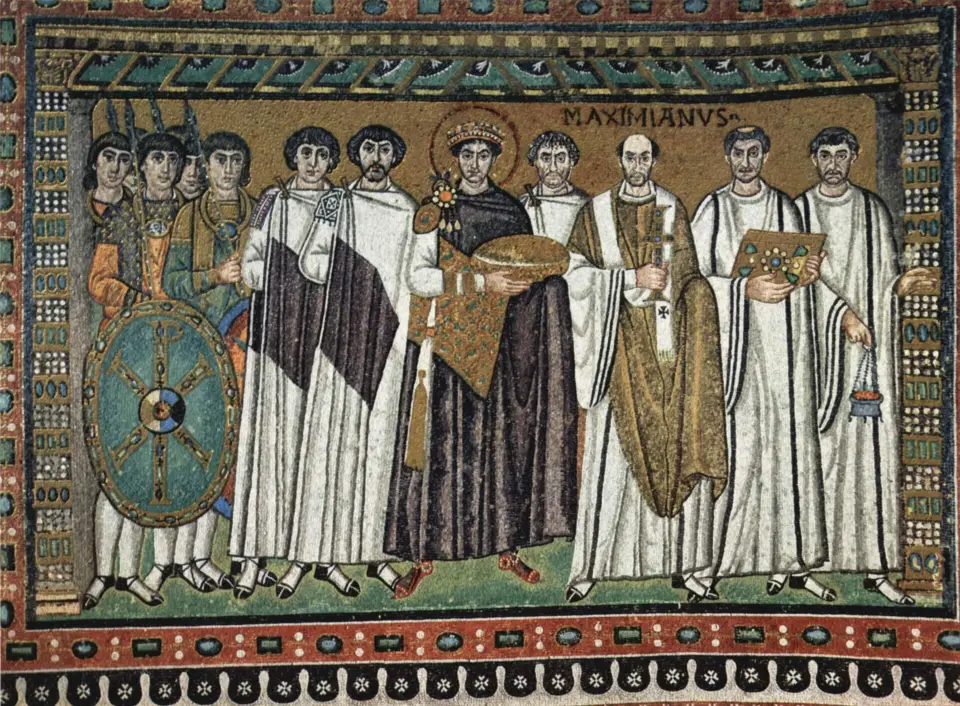
The reign of Justinian I (527–565) is regarded as the high point of the Eastern Roman (Byzantine) empire. He carried out a sweeping reform of law, the army, administration, and finances. In 533 he conquered Vandal Africa in half a year. From 535 to 553 he waged a devastating eighteen-year war against the Ostrogoths, restoring Italy and part of Spain to the empire. Yet its former grandeur was never fully recovered.
Justinian combined politics and theology. He championed a neo-Chalcedonian Christology in the spirit of Cyril of Alexandria ("one of the Trinity was incarnate") against Severus of Antioch, and sought to reconcile the Monophysites. He issued edicts against the Origenists (543) and defenders of the "Three Chapters" (544), and convened the Fifth Ecumenical Council (553).
Under him the Hagia Sophia was built in Constantinople as the architectural embodiment of his theological program.
Key points
- Reform of law (Corpus Juris Civilis), the army, administration, and finances
- Conquest of Vandal Africa (533)
- The eighteen-year Gothic War (535–553); recovery of Italy and part of Spain
- Neo-Chalcedonian Christological policy ("one of the Trinity was incarnate")
- Construction of the Hagia Sophia in Constantinople
- Shelley: having rebuilt Hagia Sophia and consecrated it in 538, Justinian exclaimed that he had surpassed Solomon; contemporaries said the dome hung from heaven on a golden chain, and mosaics showed Constantine and Justinian offering city and church to the Mother of God. Justinian never separated the Roman state tradition from Christianity: he defined his mission as “maintaining the Christian faith in its purity and defending the Church from every disturbance”, saw himself as God's servant and the empire as an instrument of His plan. In 395 Theodosius divided the empire between his sons (Honorius West, Arcadius East), and East and West diverged. The early Church saw itself as a living organism incompatible with natural societies; Byzantine doctrine read the “body of the empire” otherwise: the emperor was God’s visible representative; the Church’s boundaries blurred, and the idea of its radical strangeness to the world vanished
People
- Justinian I
- Severus of Antioch
Place
Constantinople, North Africa, Italy
Sources
- Jaroslav Pelikan – The Christian Tradition: A History of the Development of Doctrine, vol. 1 (Russian edition), p. 367–377
- Tony Lane – Christian Thinkers (Russian edition), p. 70, 74–75
- J. North – A History of the Church (Russian edition), p. 102–103
- Bruce L. Shelley – Church History in Plain Language (Russian edition), Ch. 15, sec. «Воля Божья в обществе людей», «Юстиниан и устранение границ»; Ch. 15, sec. «Юстиниан и устранение границ»
Data compiled: 2026-11-09