1652–1667 · 17th century
Patriarch Nikon's Reform and the Old Believer Schism
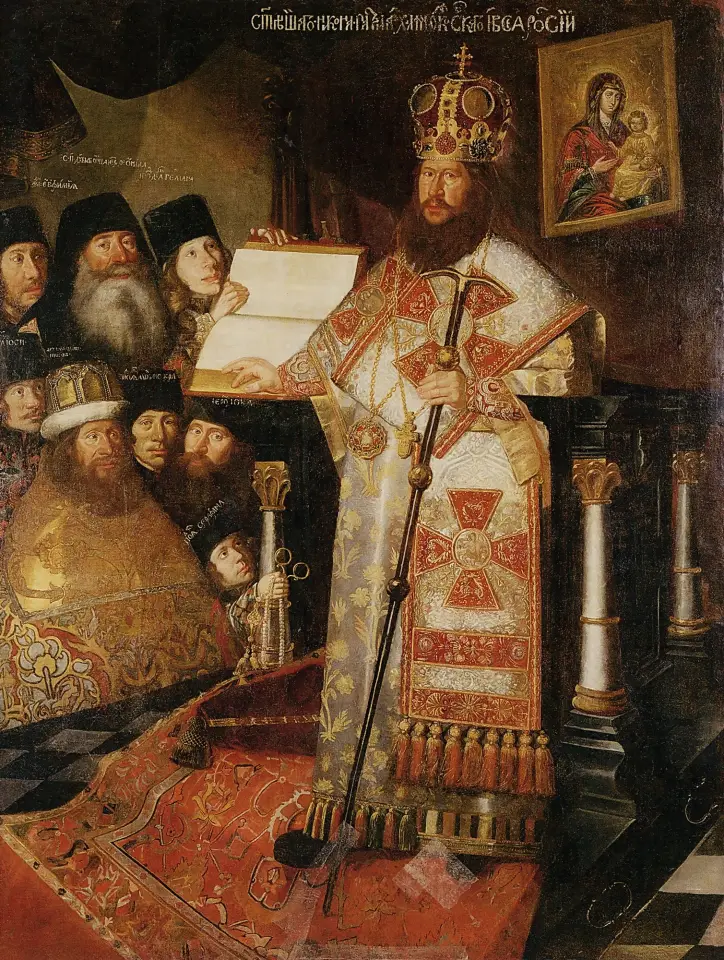
Nikon became Patriarch in 1652. Tsar Alexei Mikhailovich dreamed of Constantinople. Acting on the Tsar's political ambitions, Nikon ordered the Russian liturgical books and rites corrected to match contemporary Greek models.
His opponents held that the "Third Rome" should not conform to a fallen Constantinople. They drew support from monks and the lower classes. They formed the Old Believer party, led by the exiled Archpriest Avvakum.
The Great Moscow Council of 1666–1667 condemned the Old Believers. Force was used against them: a besieged monastery was stormed and its monks killed. Thousands resorted to mass self-immolation. The movement split into "priestly" and "priestless" factions.
Key points
- Liturgical reform to match Greek models (1652)
- Opposition led by Archpriest Avvakum
- Condemnation at the Great Moscow Council (1666–1667)
- Mass self-immolations and the split into priestly/priestless factions
People
- Nikon
- Alexei Mikhailovich
- Avvakum
- Simeon Polotsky
Place
Moscow
Sources disagree
The Great Moscow Council's year is given as 1666 or 1666–1667 in different books; the fuller range is used.
Sources
- Justo L. González – A History of Christian Thought in One Volume (Abingdon, 2014), p. 407
- Justo L. González – A History of Christian Thought, vol. III: From the Protestant Reformation to the Twentieth Century (Abingdon, rev. ed. 1987), p. 430–432, 438
- J. North – A History of the Church (Russian edition), p. 5–6
Data compiled: 2026-11-09