1945 · 20th century
The discovery of the Nag Hammadi library
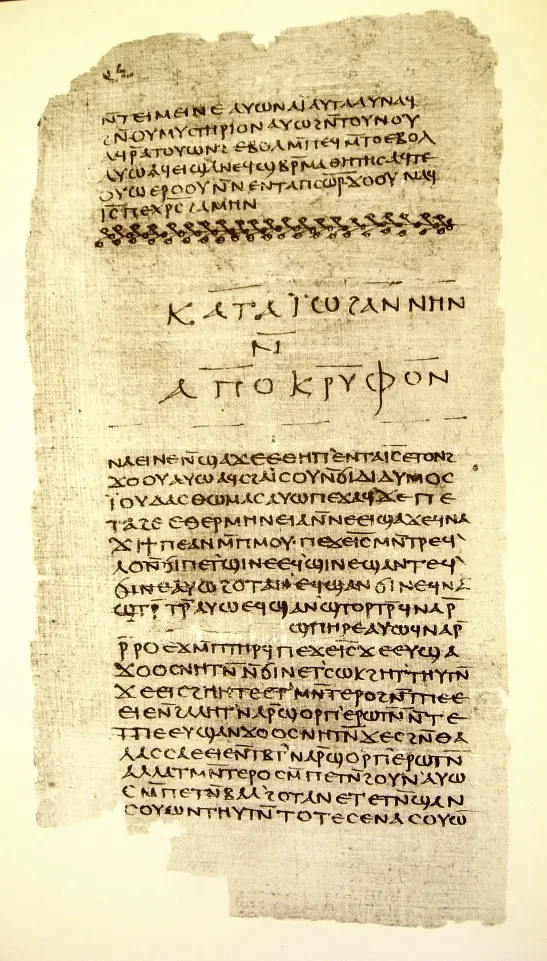
In 1945 a library of Gnostic manuscripts was discovered in Egypt, named after the nearby village of Nag Hammadi. The texts were published over the following decades. They confirmed the diversity of ancient Gnostic groups, which Irenaeus of Lyons had already compared to a many-headed Hydra. They became a crucial source for the study of early Christian Gnosticism.
Key points
- Discovered in Egypt in 1945
- Published gradually over several decades
- Confirmed the syncretistic character and diversity of Gnostic groups
- Shelley: the Gospel of Thomas was found in Egypt in 1945; the Coptic copy dates from the 4th c., Greek fragments from the 3rd; likely composition 150–200. The “Gnostic Jesus” of this gospel rejected the Torah, performed no miracles and did not rise; the Church knew such gospels and rejected them. Church Gospels were written 30–65 years after Jesus, the earliest Gnostic one perhaps after 140; the idea that winners suppressed other versions and true Christianity is in Thomas appears in The Da Vinci Code
Place
Egypt
Sources
- Stuart G. Hall – Doctrine and Practice in the Early Church (Russian edition), p. 31
- Bruce L. Shelley – Church History in Plain Language (Russian edition), Ch. 5, sec. «Евангелие Фомы»; Ch. 5, sec. «Политика и толкования», «Понимание гностицизма в наши дни»
Data compiled: 2026-11-09