1534–1535 · 16th century
The Münster Anabaptist Kingdom
After the first generation of Anabaptist leaders perished, part of the movement radicalized around the apocalyptic preaching of Melchior Hofmann in Strasbourg. Hofmann rejected the early Anabaptists' absolute pacifism.
In February 1534 his followers, led by Jan Matthys and John of Leiden, seized power in the city of Münster. They expelled the "godless" and proclaimed the city the "New Jerusalem". After Matthys's death, John of Leiden introduced polygamy and proclaimed himself king.
Catholic and Protestant forces jointly besieged the city and took it through betrayal in 1535. The leaders were tortured and executed. The fall of Münster long discredited Anabaptism as a whole and ended its revolutionary wing.
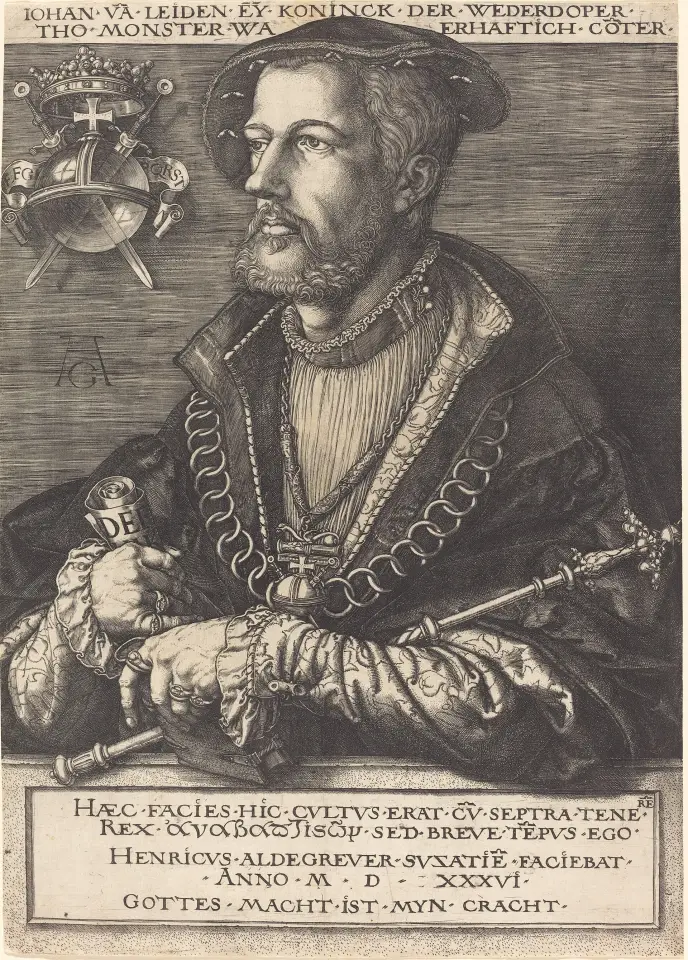
Key points
- Melchior Hofmann's apocalyptic preaching in Strasbourg
- The seizure of Münster (February 1534) and the proclamation of the "New Jerusalem"
- John of Leiden's polygamy after proclaiming himself king
- The city's fall in 1535 and the execution of its leaders
- Packull: the furrier Melchior Hoffman began as a Lutheran in Livonia, met Anabaptism in Strasbourg (1529–30) and baptized his first converts at Emden. He promised that within six months Strasbourg would become the new Jerusalem; the prophecy failed and he spent the rest of his life in prison. Jan Matthijs brought Anabaptism to Münster; his successor John of Leiden set up a “Davidic kingdom”, which fell in June 1535; its leaders were executed, and the lurid details sit ill with Anabaptist morals elsewhere. After Münster Melchiorism fragmented; Jan van Batenburg’s band (executed 1538) vanished with its leader, having implicated peaceful Melchiorites. David Joris became a mediator among factions, then a spiritualist rejecting outer rites, baptism included; his followers survived as Nicodemites
- Shelley: in Münster, after Jan Matthijs, chiliastic fanaticism began; the bishop besieged the city and Anabaptists defended it with arms. John of Leiden became a despot, introduced polygamy and styled himself “King David”; the city fell on 24 June 1535
People
- Melchior Hofmann
- Jan Matthys
- John of Leiden
Place
Strasbourg; Münster (Westphalia)
Sources
- J. North – A History of the Church (Russian edition), p. 251–252
- Justo L. González – A History of Christian Thought, vol. III: From the Protestant Reformation to the Twentieth Century (Abingdon, rev. ed. 1987), p. 95–97
- Justo L. González – A History of Christian Thought in One Volume (Abingdon, 2014), p. 305–307
- Alister McGrath – Reformation Thought (Russian edition: «Theological Thought of the Reformation»), p. 280, 379
- Tony Lane – Christian Thinkers (Russian edition), p. 193
- Justo L. González – The Story of Christianity, vol. II (Russian edition), Part 1, ch. 6
- The Cambridge Companion to Reformation Theology, ed. David Bagchi, David C. Steinmetz (2004), p. 207–208, 208, 208–209
- Bruce L. Shelley – Church History in Plain Language (Russian edition), Ch. 25, sec. «И обезумели устроители Царствия…»
More on the doctrine
- The Reformation and the last things: the rejection of chiliasm and the Münster "kingdom" (16th century (Münster – 1525–1535))
Data compiled: 2026-11-09