1536 · 16th century
Menno Simons and the revival of peaceful Anabaptism
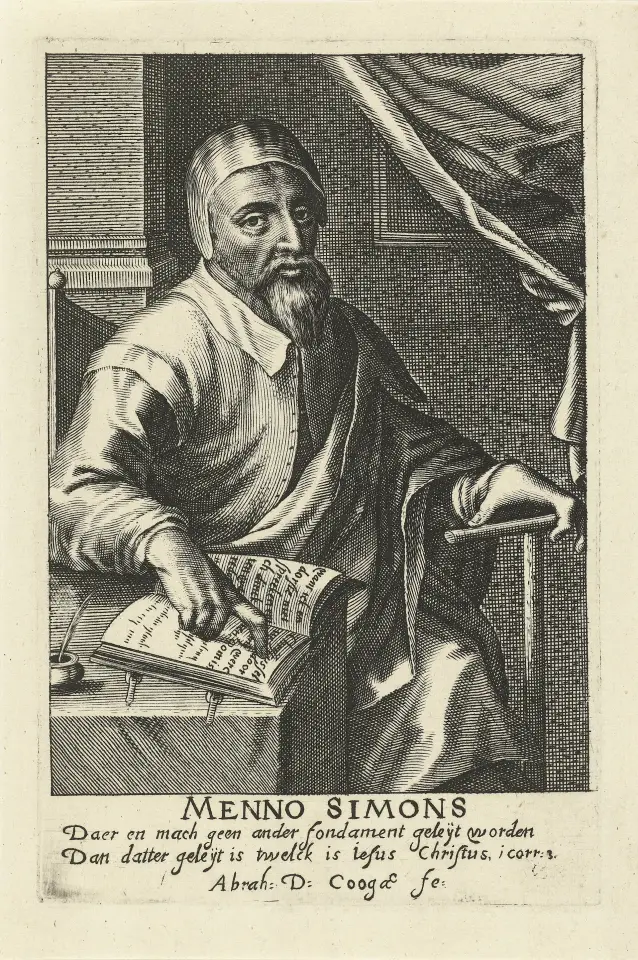
The Dutch Catholic priest Menno Simons joined the Anabaptists in early 1536. He soon led their moderate wing, decisively distancing it from the violence of Münster.
In his tract "Foundation of Christian Doctrine" he set out the vision of a community separated from the world. Such a community practises believers' baptism and "loving excommunication". Menno made pacifism the essence of the new movement, which took the name Mennonites after him.
The Mennonites preserved this principled rejection of violence over the following centuries. They spread across Europe and later to North and South America.
Key points
- Menno Simons joins the Anabaptists (1536)
- Rejection of Münster's violence
- "Foundation of Christian Doctrine": a church separated from the world
- Pacifism as the Mennonites' distinguishing feature
- Packull: Obbe Philips, who probably baptized Menno, was won by Jan Matthijs’s emissaries and later, doubting his baptism, left the movement. Menno and Dirk Philips denounced Münsterite violence and Jorist Nicodemism, insisting on visible, separated congregations; Menno’s relationship to the Melchiorites remains controversial (Friesen denies any connection). By the later 16th century “Mennonites” dominated the north, from Holland to Schleswig-Holstein and the Vistula delta. Through a misunderstanding between Hoffman and Schwenckfeld a “heavenly flesh” Christology entered Anabaptism in the north: Schwenckfeld spoke of progressive divinization of Christ’s humanity; Hoffman projected it to conception – Christ brought his flesh from heaven; through Dirk Philips and Menno Simons this Christology reached the Mennonites. Following Voolstra, for Menno it served church purity (the congregation’s sanctified life as visible proof of Christ); docetism charges are unfounded
- Shelley: after Münster the Lower Rhine Anabaptists regained strength through the ministry of Menno Simons (c. 1496–1561), a former priest: at great risk he gathered scattered groups in northern Europe and inspired them with night sermons. Menno’s name embodied renouncing violence; not the movement’s founder, yet Anabaptist descendants are called Mennonites; of these only the Old Order Amish strictly keep the ancient ways
- Rempel: Dirk Philips (1504–1568), Menno Simons’s colleague, kept the doctrine of Christ’s “unsullied” flesh and listed seven “ordinances” of the church.
People
- Menno Simons
- Obbe Philips
- Dirk Philips
Place
the Netherlands
Sources
- Justo L. González – A History of Christian Thought, vol. III: From the Protestant Reformation to the Twentieth Century (Abingdon, rev. ed. 1987), p. 97–99
- Justo L. González – A History of Christian Thought in One Volume (Abingdon, 2014), p. 307–308
- J. North – A History of the Church (Russian edition), p. 252
- Justo L. González – The Story of Christianity, vol. II (Russian edition), Part 1, ch. 6
- The Cambridge Companion to Reformation Theology, ed. David Bagchi, David C. Steinmetz (2004), p. 209, 218–219
- Bruce L. Shelley – Church History in Plain Language (Russian edition), Ch. 25, introduction; sec. «И обезумели устроители Царствия…»
- The Oxford Handbook of Sacramental Theology, ed. Hans Boersma, Matthew Levering (2015), p. 371–373, 371
Data compiled: 2026-11-09