1201–1226 · 13th century
The Mendicant Orders: Francis of Assisi and Dominic
Francis of Assisi was the son of a wealthy merchant. He renounced his father's inheritance. In late 1209, after hearing Matthew 10:7–10, he combined poverty with urban preaching. Innocent III orally approved the founding of the Order of Friars Minor. In 1212 Clare of Assisi founded the women's order of "Poor Clares".
Francis called himself "wedded to Lady Poverty". In 1219 he went on mission to Egypt himself. In 1220 he laid down leadership of the order. He died on 3 October 1226 with the words "Welcome, Sister Death!".
Dominic was a canon of Osma. In southern France he was shaken by the contrast between the Albigensians' humility and the papal legates' greed. He resolved to fight heresy through preaching, strict living, and learning. His Order of Preachers was approved by the pope in 1216. It valued education from the start and quickly took up chairs at Paris and Oxford. It gave the Church Albert the Great and Thomas Aquinas.
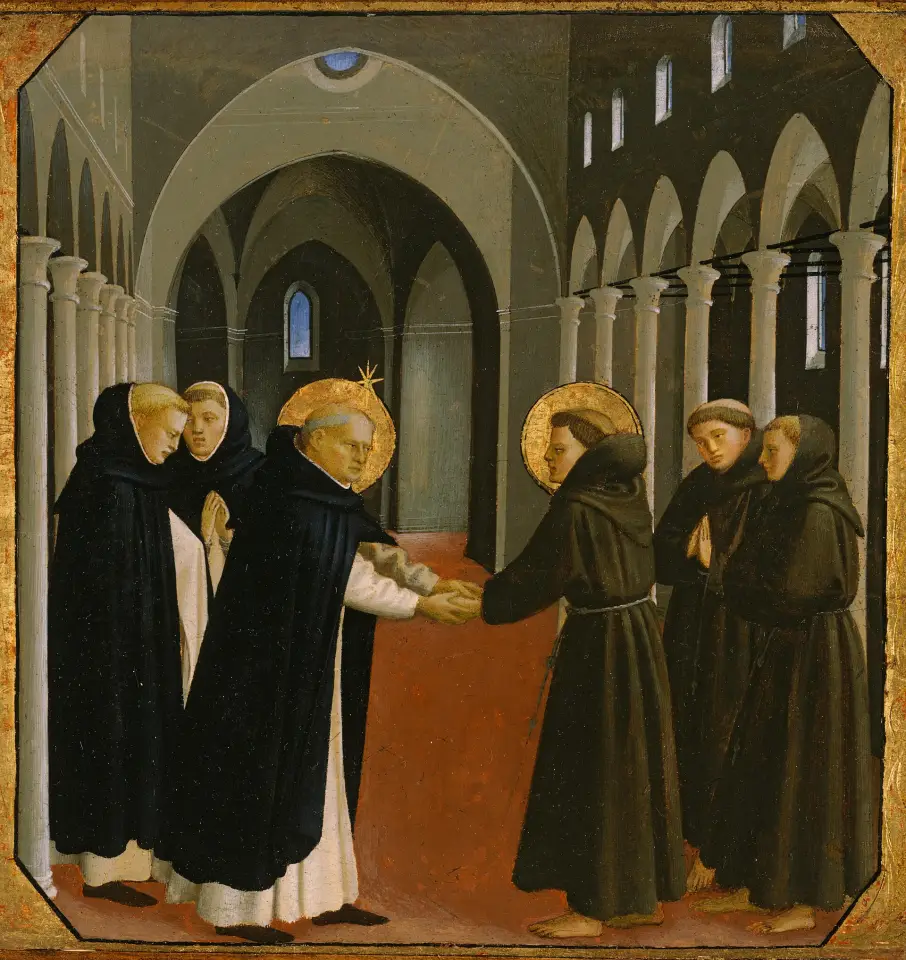
Key points
- Francis's vow of absolute poverty and Innocent III's approval of the order
- The founding of the women's order of 'Poor Clares' (1212)
- Papal approval of the Dominican order (1216)
- The Dominicans' role in university education and later in the inquisition
- Shelley: Francis (1182–1226), a merchant’s son, after captivity and visions left home and preached the joy of apostolic poverty. In 1209 he wrote a rule from Christ’s words and won Innocent III’s approval; in 1219 he vainly tried to convert the sultan. While Francis was away the brotherhood changed: some wanted organization and supervision for growth, others held to the original principles. Francis, no administrator, asked the pope to appoint Cardinal Ugolino (later Gregory IX) adviser and handed government to Pietro Cattaneo: “Lord Jesus, I give back to You Your family… I no longer have strength or ability to care for it”. Ugolino saw in the order a chance to strengthen the Roman Church, transforming it through the Franciscans’ authority; Francis wanted to transform the world through Christlike humility. In 1223 Honorius III confirmed a new rule that allowed complex organization and made begging a basic feature of the order. Francis died on 3 October 1226, praising God in song; within a hundred years the order split into Conventuals, who allowed property use, and Spirituals, who held perfect poverty the sign of the true Church. In 1220 the Dominicans’ mission and way of life received approval; the mendicants sought to live among people, serving townspeople’s spiritual needs. Franciscans and Dominicans were partners in the “great mendicant counteroffensive”; in 1220 the Inquisition passed to the Dominicans
- Rowland: Franciscans, steeped in Joachite ideas, saw Francis as the angel of Revelation 7; Olivi saw him as inaugurator of the sixth age and the worldly Church as the whore of Babylon (Rev 17)
- McGinn: Francis the stigmatic, perfect image of Christ’s saving love, became the core of Franciscan mysticism; first Life by Thomas of Celano (1228–9). The Franciscan line is rich in women mystics: Angela of Foligno (d. 1309; texts recorded by her confessor), Catherine of Bologna (d. 1463)
People
- Francis of Assisi
- Clare of Assisi
- Innocent III
- Dominic
- Albert the Great
- Thomas Aquinas
- Alexander of Hales
- Peter Olivi
Place
Assisi; Toulouse; Southern France; Paris; Oxford
Sources disagree
Bruce (Shelley) places the official approval of the Dominican order in 1220; the site record has the pope recognizing the order in 1216.
Sources
- J. North – A History of the Church (Russian edition), p. 192–194
- Justo L. González – The Story of Christianity, vol. I (Russian edition), Ch. 25, sec. 25.1
- Justo L. González – A History of Christian Thought in One Volume (Abingdon, 2014), p. 245–246
- Tony Lane – Christian Thinkers (Russian edition), p. 121–123
- Bruce L. Shelley – Church History in Plain Language (Russian edition), Ch. 21, introduction и sec. «Орден францисканцев»; Ch. 21, sec. «Орден францисканцев»; Ch. 21, sec. «Расцвет доминиканцев»
- The Oxford Handbook of Apocalyptic Literature, ed. John J. Collins (2014), p. 427
- The Oxford Handbook of Mystical Theology, ed. Edward Howells, Mark A. McIntosh (2020), Ch. 4, sec. «Franciscan Mysticism»
Data compiled: 2026-11-09