1553–1558 · 16th century
Mary Tudor's Catholic restoration
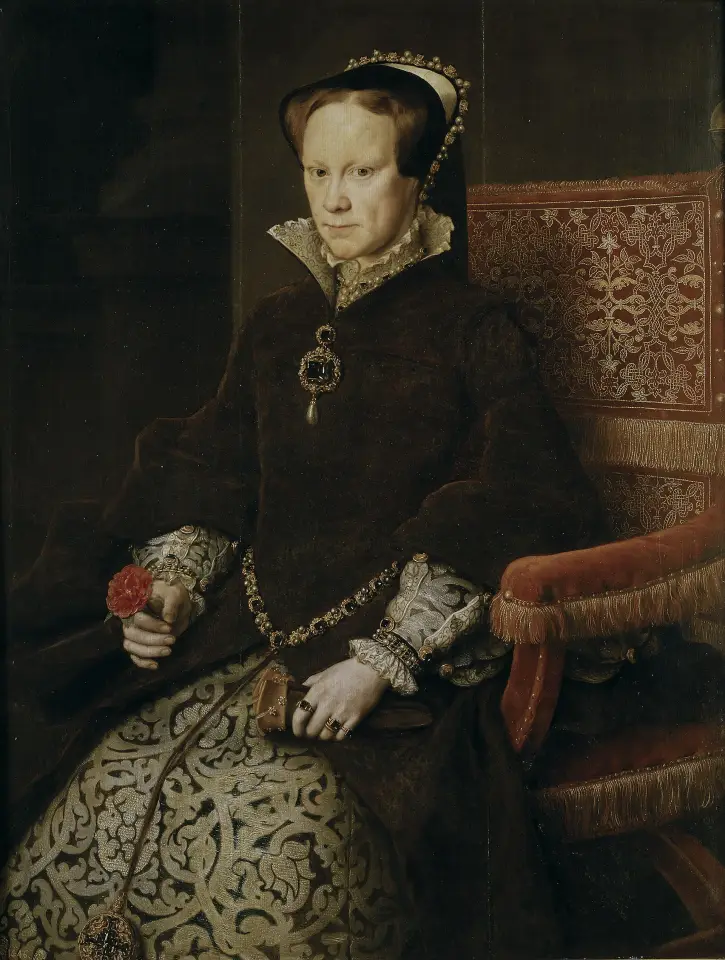
After Edward VI's death in 1553, Mary Tudor came to the throne. She repealed her brother's Protestant laws and in late 1554 returned England to Roman obedience. She also married Philip of Spain.
From 1555 onward brutal persecution unfolded. About three hundred Protestants were burned, including bishops Latimer and Ridley (October 1555). Archbishop Cranmer was burned too. Before his execution he recanted his forced recantation and thrust his signing right hand into the flames first.
The persecution earned the queen the nickname "Bloody Mary". But, contrary to its aim, it only strengthened English sympathy for Protestantism. Many Protestants fled to the continent, where they absorbed more radical Reformed ideas.
Key points
- England's return to Roman jurisdiction (late 1554)
- About 300 Protestants burned
- The execution of bishops Latimer and Ridley (October 1555) and Archbishop Cranmer
- Protestant emigration to the continent, where Reformed ideas were absorbed
- Shelley: in four years Mary I sent at least three hundred Protestants to the stake, Cranmer among them; Foxe gave her the name Bloody Mary. Mary was perhaps England’s only truly devout 16th-century ruler, but she made martyrs; her zeal and marriage to Philip were seen as betrayal. Foxe's Book of Martyrs, like the Geneva Bible, was produced by English exiles driven out by Bloody Mary. Foxe described Protestants ready to die for God's Kingdom and traced persecution of martyrs to England and Mary's reign; in his view God has a special place for the English people in the plan of redemption. Apart from the Bible, Foxe's book shaped the English mind more than any other. Under the Bible and Foxe the Puritans came to think of themselves as the new Israel; many first Puritans were Protestants driven to Geneva under Mary (1553–1557). Within half a century of Foxe's death the Puritans carried his work and philosophy of history across the Atlantic
People
- Mary I Tudor
- Philip II of Spain
- Thomas Cranmer
- Hugh Latimer
- Nicholas Ridley
Place
England
Sources
- J. North – A History of the Church (Russian edition), p. 264–266
- Justo L. González – A History of Christian Thought, vol. III: From the Protestant Reformation to the Twentieth Century (Abingdon, rev. ed. 1987), p. 189, 196
- Tony Lane – Christian Thinkers (Russian edition), p. 150, 199–200
- Justo L. González – A History of Christian Thought in One Volume (Abingdon, 2014), p. 332
- Justo L. González – The Story of Christianity, vol. II (Russian edition), Part 1, ch. 8
- Bruce L. Shelley – Church History in Plain Language (Russian edition), Ch. 27, sec. «Уклон в протестантизм»; Ch. 30, sec. «Пуританство: новая жизнь и новый мир», «Люди Книги»
Data compiled: 2026-11-09