1813–1855 · 19th century
Søren Kierkegaard
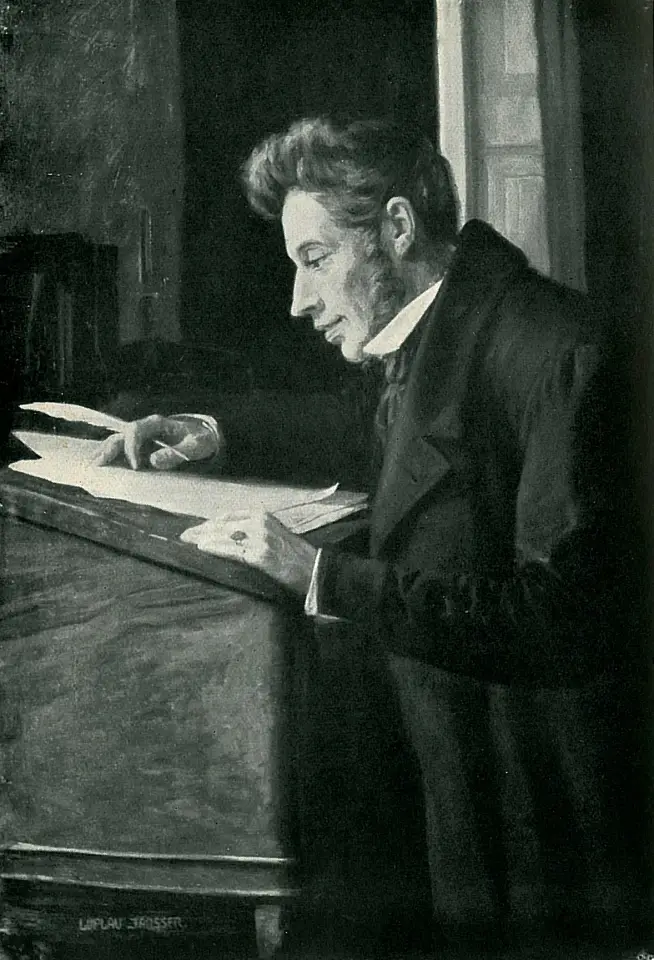
The Dane Søren Kierkegaard earned a theology degree in 1840 and broke his engagement to Regine Olsen in 1841. He saw his calling as making Christianity difficult again and attacked the "Christendom" that had turned faith into a mere game of being Christian. He wrote his works (Fear and Trembling, Philosophical Fragments, etc.) under pseudonyms, having rejected Hegel's "System." In 1854–1855 he openly attacked the official Danish church and its clergy.
Almost unheard in his own century, he is regarded as the founder of existentialism and strongly influenced the young Karl Barth.
Key points
- Theology degree (1840) and the broken engagement to Regine Olsen (1841)
- Works under pseudonyms; rejection of Hegel's "System"
- Attack on the official Danish church (1854–1855)
- Almost unheard in his lifetime; influence on the young Barth
- Gunton: in book after book Kierkegaard accused Hegel of so systematising the content of the faith that he turned it into a philosophy.
People
- Søren Kierkegaard
- Regine Olsen
- Georg Wilhelm Friedrich Hegel
- Karl Barth
Place
Copenhagen, Denmark
Sources
- Justo L. González – The Story of Christianity, vol. II (Russian edition), Part 3, ch. 28, section «Работа Кьеркегора»
- Tony Lane – Christian Thinkers (Russian edition), p. 274–276
- Stanley Grenz, Roger Olson – 20th-Century Theology: God and the World in a Transitional Age (Russian edition), p. 86–88
- Justo L. González – A History of Christian Thought in One Volume (Abingdon, 2014), p. 391–393
- Justo L. González – A History of Christian Thought, vol. III: From the Protestant Reformation to the Twentieth Century (Abingdon, rev. ed. 1987), p. 372–381
- The Cambridge Companion to Christian Doctrine, ed. Colin E. Gunton (1997), p. 33
Data compiled: 2026-11-09