62 AD · 1st century
The execution of James, the Lord's brother, and the relocation of the Jerusalem Christians to Pella
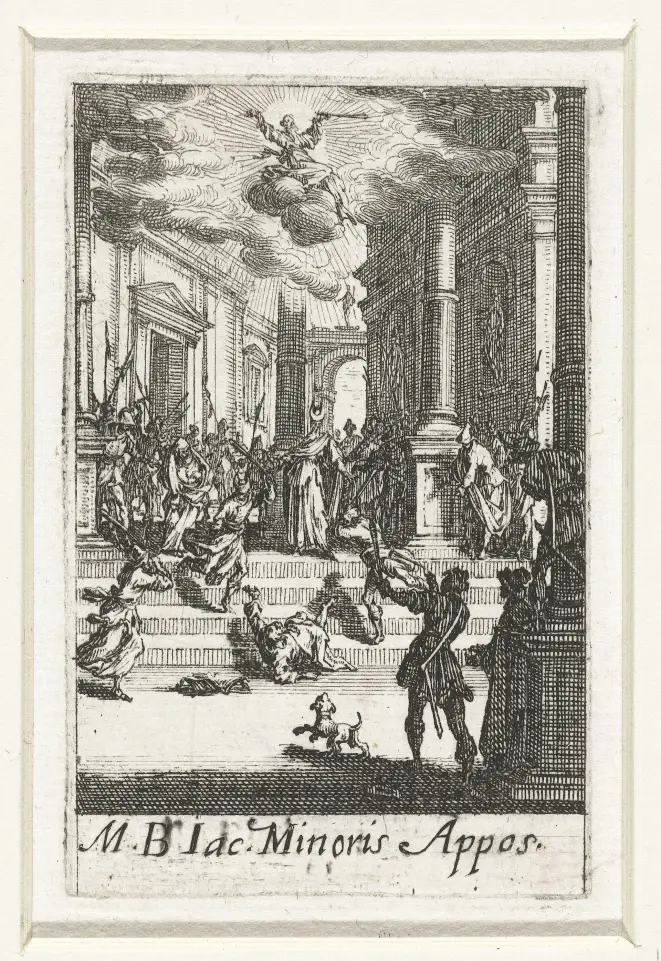
The procurator Festus had died, and his successor Albinus had not yet arrived. The high priest Ananus the Younger, a man of harsh temper from the Sadducee party, took advantage of this interregnum. He convened the Sanhedrin and brought before it James, "the brother of Jesus, who was called Christ", together with several others. He charged them with breaking the law and had them stoned.
The city's most respected legal experts condemned this unauthorized convening of the Sanhedrin. They complained to the new governor Albinus and to King Agrippa II. Ananus was deposed from the high priesthood only three months after his appointment.
James, who had headed the Jerusalem church, was killed against the wishes of the Pharisees. Earlier Herod Agrippa had already executed James the brother of John and arrested Peter. After James's murder the community's leaders soon relocated to Pella across the Jordan. Leadership of the community passed to another relative of Jesus, Simon, who was later also killed by the Romans.
The Jewish church found itself isolated and absorbed the views of the sects around it. By 135 AD some Jewish Christians had returned to Jerusalem. But ties with the rest of the church were almost severed, and leadership had passed to Gentile Christians.
Key points
- Ananus the Younger took advantage of the absence of a Roman governor to convene the Sanhedrin
- James, the Lord's brother, and others were condemned to stoning
- The city's legal experts condemned Ananus's high-handedness; King Agrippa II deposed him
- The Jerusalem community relocated to Pella; leadership passed to Simon, a relative of Jesus
- Leadership within the church passed to Gentile Christians
People
- James, the brother of Jesus
- Ananus the Younger
- Agrippa II
- Albinus
- James, the brother of John
- Herod Agrippa
- Simon
Place
Jerusalem; Pella
Sources disagree
The year of James's execution is traditionally placed in 62 AD (the period between Festus's death and Albinus's arrival); the sources give no exact date for the move to Pella ("soon after this").
Sources
Primary sources
- Flavius Josephus – Jewish Antiquities; The Jewish War (Russian edition), Antiquities, bk. XX, ch. 9
Textbooks
- Justo L. González – The Story of Christianity, vol. I (Russian edition), Ch. «Иерусалимская церковь», sec. 1.5–1.6
Data compiled: 2026-11-09