1524–1525 · 16th century
The German Peasants' War
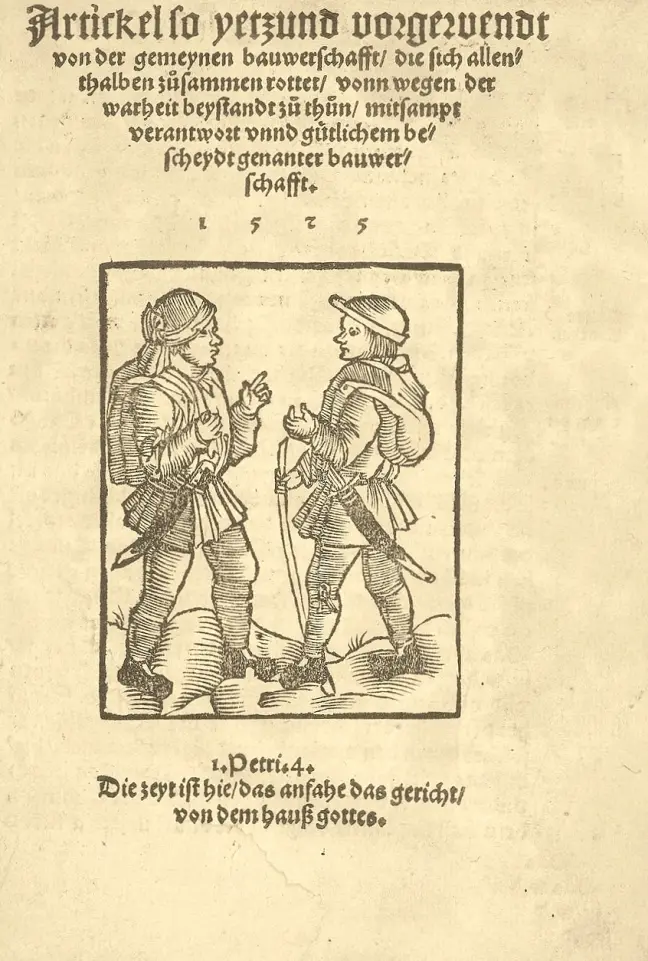
Inspired by the idea of Christian freedom, German peasants set out demands in the "Twelve Articles", appealing to Scripture: in article 12 they promised to recede from any article proved "by a clear explanation of the Scripture" to be against the word of God. Some rebels rallied to the theocratic preaching of Thomas Müntzer.
Luther first acknowledged the justice of some demands. But once violence spread widely, he urged the princes to crush the revolt by force. He did so in his tracts "Admonition to Peace" and "Against the Murderous, Thieving Hordes of Peasants" (May 1525).
The revolt was crushed: over 100,000 peasants died, and Müntzer was executed. Many saw Luther as a traitor to the cause of freedom. He himself came away distrusting ordinary believers' ability to interpret Scripture on their own.
Key points
- The peasants' "Twelve Articles" (Memmingen)
- Thomas Müntzer's theocratic preaching
- Luther's call to crush the revolt and Müntzer's execution (27 May 1525)
- Over 100,000 peasants died
- Shelley: German peasants, inspired by Christian freedom, applied it to economics and rose against the lords in 1524; their twelve demands included release from serfdom, "unless it should be shown us from the Gospel that we are serfs" (art. 3), and relief from the excessive services demanded of them (art. 6). Luther first acknowledged the peasants' justice, but at their violence issued Against the Murderous Hordes, urging princes to “kill, strangle, stab”. The uprising was crushed in 1525, with about a hundred thousand peasants dead; survivors considered Luther a false prophet, and many returned to Catholicism or turned to the radical Reformation. Luther stayed conservative in politics and economics, and princes embraced Lutheranism partly for control of the Church and wealth
- Weber: Müntzer, once Luther’s ally, saw himself as the last prophet before the Parousia and urged the saints to destroy the godless for Christ’s kingdom; in the Peasants’ War he incited the peasants and signed letters “sword of Gideon”, and in 1525 he was beheaded
- Rowland: in his 1524 sermon on Daniel 2 Müntzer told the princes that Christ the Stone would shatter the last empire and a “new Daniel” must lead. He read Romans 13 (“not bearing the sword in vain”) as a duty of princes to root out the wicked; quiet waiting on God would not do. He put visions above “book religion”: first experience, then Scripture, which only tests the experience. Before Frankenhausen (May 1525) a rainbow was taken as a good omen; the peasants were routed, Müntzer captured, tortured, executed
People
- Martin Luther
- Thomas Müntzer
- Franz von Sickingen
Place
Germany
Sources
Primary sources
- The Twelve Articles of the Swabian Peasants (1525), art. 3, 6, 12
Textbooks
- Justo L. González – The Story of Christianity, vol. II (Russian edition), Part 1, ch. 4
- Alister McGrath – Reformation Thought (Russian edition: «Theological Thought of the Reformation»), p. 225, 295–296, 378
- J. North – A History of the Church (Russian edition), p. 242
- Justo L. González – A History of Christian Thought, vol. III: From the Protestant Reformation to the Twentieth Century (Abingdon, rev. ed. 1987), p. 90, 92
- Bruce L. Shelley – Church History in Plain Language (Russian edition), Ch. 24, sec. «Еретик, преступник, герой»
- The Oxford Handbook of Eschatology, ed. Jerry L. Walls (2008), Ch. 20, sec. «The Reformation»
- The Oxford Handbook of Apocalyptic Literature, ed. John J. Collins (2014), p. 430
Data compiled: 2026-11-09