1453 · 15th century
The Fall of Constantinople
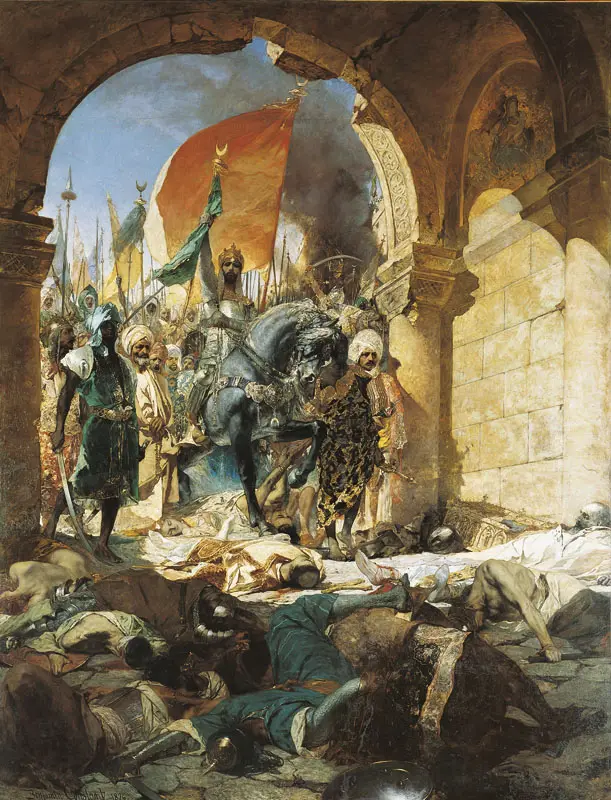
On the evening of 28 May 1453, the people of Constantinople gathered in Hagia Sophia for the last Christian service held in the cathedral. That night the Ottoman Turks under Mehmed II broke through the walls. Three days of plunder followed, and the sultan then turned Hagia Sophia into a mosque. Emperor Constantine XI Palaiologos died in the fighting.
Thus ended the existence of the eastern part of the former Roman Empire – the New Rome. By promise, it was supposed to stand until the end of the age.
The Ottomans soon organized the non-Muslim population under the "millet" system. The Patriarch of Constantinople was granted broad administrative and judicial authority over the empire's Orthodox Christians. The philosopher George Scholarios became one of the first patriarchs after the conquest, as Gennadios II. At Mehmed II's request he wrote a confession of faith, "On the One Path of Man's Salvation".
Byzantine scholars and manuscripts who fled west made a significant contribution to the European Renaissance. Orthodoxy, having lost its imperial mainstay, increasingly leaned on the Russian church.
Key points
- The storming and capture of Constantinople on 28–29 May 1453
- The death of Emperor Constantine XI and Hagia Sophia's conversion into a mosque
- The introduction of the Ottoman millet system for Orthodox Christians
- The migration of Byzantine scholars to the West and their contribution to the Renaissance
People
- Mehmed II
- Constantine XI Palaiologos
- Gennadios II Scholarios
Place
Constantinople
Sources disagree
North and Pelikan (vol. 2) / González (Christian Thought) give 28–29 May 1453.
Sources
- Justo L. González – A History of Christian Thought in One Volume (Abingdon, 2014), p. 235, 238
- Tony Lane – Christian Thinkers (Russian edition), p. 70–71
- Alister McGrath – Reformation Thought (Russian edition: «Theological Thought of the Reformation»), p. 376
- Jaroslav Pelikan – The Christian Tradition, vol. 2: The Spirit of Eastern Christendom (600–1700) (Russian edition), p. 90, 382–383, 396–397, 419
- J. North – A History of the Church (Russian edition), p. 3–4, 226
- Justo L. González – The Story of Christianity, vol. II (Russian edition), Part 4, ch. 32
Data compiled: 2026-11-09