early 5th c.; council – May 411 · 4th century
The Donatist controversy and Augustine's ecclesiology
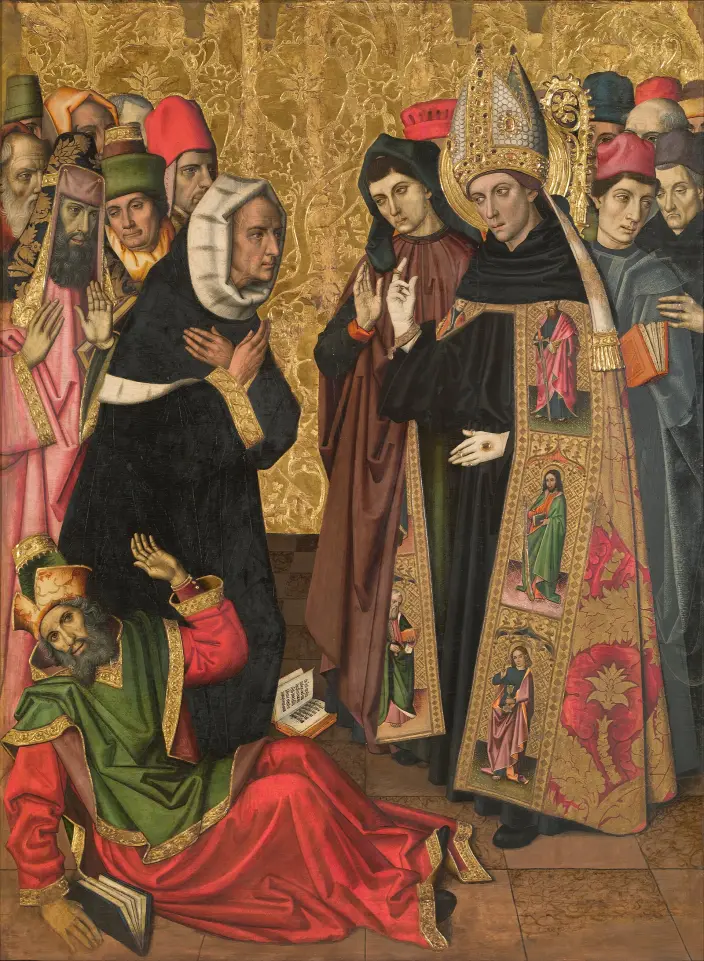
In the early 5th century Augustine of Hippo waged a theological struggle against Donatism, which equated the Church's holiness and unity with the personal purity of its clergy. Augustine insisted that the validity of the sacraments does not depend on the moral state of the minister, and that schism is a greater sin than tolerating unworthy members within a united Church.
Augustine's arguments received official status at the Council of Carthage in May 411. Later reformers (per B. Warfield's formula) held that the Reformation was "the triumph of Augustine's doctrine of grace over Augustine's doctrine of the Church."
Key points
- The Donatists demanded that the Church be purged of clergy who had "betrayed" the faith under persecution
- A dispute over the validity of baptism administered by an unworthy bishop
- The Council of Carthage in 411 gave Augustine's arguments the status of official teaching
- Later reformers separated Augustine's doctrine of grace from his ecclesiology
- Shelley: the Donatists, named for Donatus, accused Catholic bishops of apostasy under Diocletian and held themselves the true Church; by Augustine’s day they were in places a majority. Augustine rejected a “Church of the pure”: until the Judgment the Church is mixed, wheat and tares
People
- Augustine of Hippo
- Petilian the Donatist
- Optatus of Milevis
- Benjamin B. Warfield
Place
North Africa, Carthage
Sources
- Alister McGrath – Reformation Thought (Russian edition: «Theological Thought of the Reformation»), p. 193
- Louis Berkhof – History of Christian Doctrines (Russian edition), p. 167–169, 192
- Jaroslav Pelikan – The Christian Tradition: A History of the Development of Doctrine, vol. 1 (Russian edition), p. 331–337
- Bruce L. Shelley – Church History in Plain Language (Russian edition), Ch. 13, sec. «Конфликты с донатистами»
More on the doctrine
- The Donatist controversy: the holiness of the Church and the validity of the sacraments (early 4th century (from 311))
- Augustine on the sacraments: validity, efficacy and sign (late 4th – early 5th century)
- Augustine: the mixed body, the visible and the invisible Church (early 5th century)
Data compiled: 2026-11-09