8 October – 10 November 451 · 5th century
The Fourth Ecumenical Council (Chalcedon)
After the death of Theodosius II, the new rulers Marcian and Pulcheria convened an ecumenical council. It opened at Chalcedon on 8 October 451. It was the largest gathering of the ancient Church, with 500 to 630 fathers.
The council overturned the decisions of the 449 "Robber Council." It deposed Dioscorus of Alexandria in absentia, condemning him not for his faith but for insubordination. It also rehabilitated the victims of 449 – Theodoret of Cyrus, Ibas of Edessa, and others.
The fathers recognized the Nicene and Constantinopolitan creeds and Cyril of Alexandria's letters as a sufficient basis of faith. Even so, after prolonged disputes, they adopted a new Definition on 22 October. The disputes notably concerned whether Leo the Great's "Tome" was compatible with Cyril's teaching.
The Definition proclaimed one Christ, perfect in Godhead and perfect in manhood, consubstantial with the Father in Godhead and with us in manhood. He is acknowledged "in two natures" without confusion, without change, without division, without separation, united in one Person and one Hypostasis.
Canon 28 placed the Patriarch of Constantinople on an equal honor with Rome. This provoked a sharp protest from the papal legates and Pope Leo himself.
The Definition became the norm for the West and most of the East. But it was rejected by a substantial part of the East (Egypt, Syria, Armenia), giving rise to a lasting Monophysite schism.
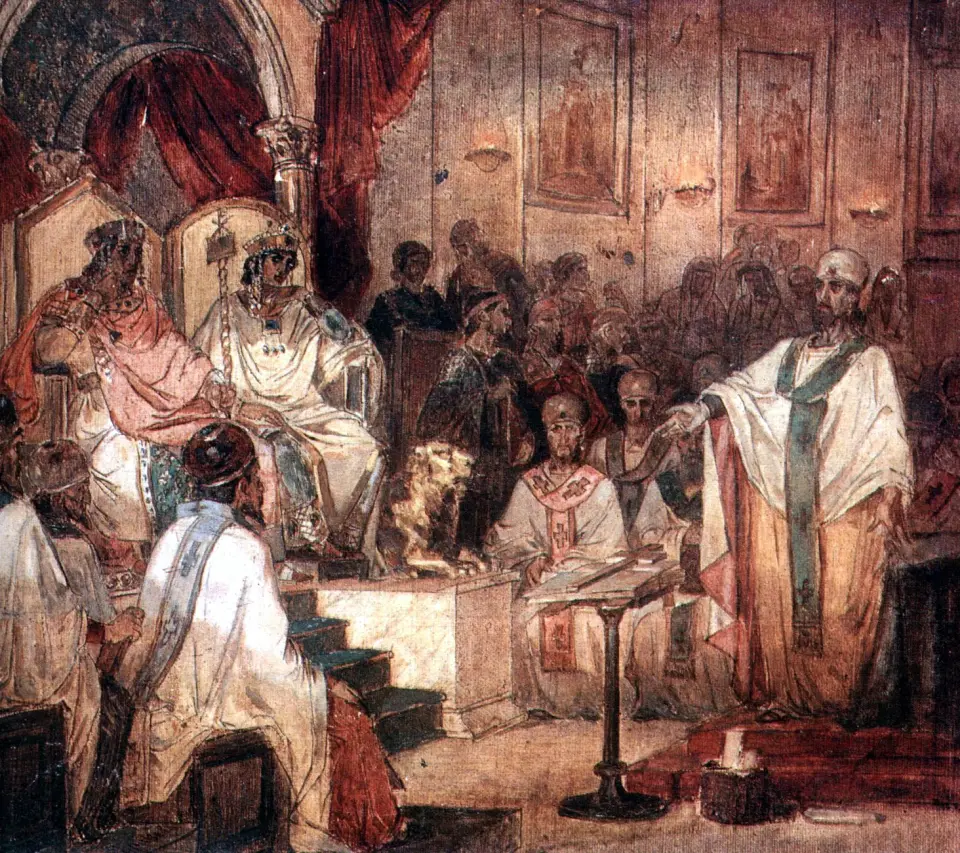
Key points
- Dioscorus of Alexandria deposed in absentia for insubordination, not heresy
- Rehabilitation of the victims of the "Robber Council": Theodoret, Ibas of Edessa, Flavian (posthumously)
- The Chalcedonian Definition: one Person, "in two natures," without confusion, change, division, or separation
- The Definition drew on Cyril's letters, the 433 "Formula of Reunion," and Leo the Great's "Tome"
- Canon 28 placed Constantinople on equal honor with Rome; Pope Leo rejected it
- The Definition was rejected by large parts of the East (Egypt, Syria, Armenia) – the start of the Monophysite schism
- Weinandy: Chalcedon’s Fathers at first meant only to reaffirm the 381 Creed, Cyril’s letter to Nestorius and Leo’s Tome, then saw a new definition as needed. The definition repeats ‘one and the same’ three times and ‘the same’ five: this is Cyril’s voice – the one subject is the eternal Son; ‘in two natures’ (rather than ‘out of two’) resolves Cyril’s ambiguity, and Cyril’s teaching is the key to reading the definition.
People
- Marcian
- Pulcheria
- Leo the Great
- Dioscorus of Alexandria
- Anatolius of Constantinople
- Theodoret of Cyrrhus
- Ibas of Edessa
- Juvenal of Jerusalem
- Eusebius of Dorylaeum
Place
Chalcedon
Sources
- A. P. Lebedev – History of the Ecumenical Councils, part II, p. 271–298, 319–320
- A. P. Lebedev – History of the Ecumenical Councils, part I, p. 198–244, 337–339
- Jaroslav Pelikan – The Christian Tradition: A History of the Development of Doctrine, vol. 1 (Russian edition), p. 281–284
- Stuart G. Hall – Doctrine and Practice in the Early Church (Russian edition), p. 150–153
- Justo L. González – The Story of Christianity, vol. I (Russian edition), Ch. 21, sec. 21.1–21.2
- Jaroslav Pelikan – The Christian Tradition, vol. 2: The Spirit of Eastern Christendom (600–1700) (Russian edition), p. 119–120, 130, 133, 149, 269–270, 286
- Louis Berkhof – History of Christian Doctrines (Russian edition), p. 72–73
- Justo L. González – A History of Christian Thought in One Volume (Abingdon, 2014), p. 161–163
- Tony Lane – Christian Thinkers (Russian edition), p. 63–67
- J. North – A History of the Church (Russian edition), p. 77–79
- The Oxford Handbook of Christology, ed. Francesca Aran Murphy (2015), p. 669–671
More on the doctrine
Data compiled: 2026-11-09