1438–1439 · 15th century
The Council of Ferrara-Florence and the Union of East and West
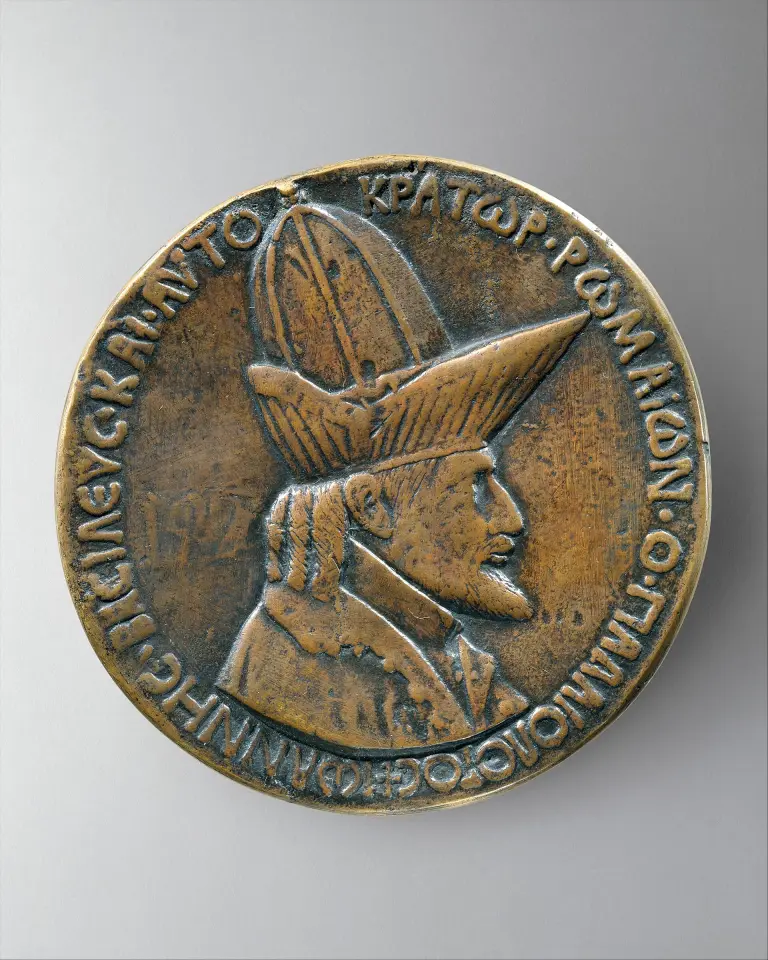
Pressed by the Turks, the Greeks sought Western military aid. A council was held first at Ferrara, then Florence and Rome (1438–1445). After eight months of debate over the Filioque, the Byzantine delegates made major concessions.
They accepted the Filioque as "one principle" (the formula "from the Father through the Son"). They accepted the doctrine of purgatory and of the Eucharist's consecration by the words of institution rather than the epiclesis. They also accepted papal supremacy over the whole church. In 1439, 115 Western and 33 Eastern representatives signed the agreement.
That same year the "Decree for the Armenians" was issued. It gave the first conciliar definition of Peter Lombard's seven sacraments. This was later confirmed by the Council of Florence for the whole Latin church.
Yet military aid never came. Once home, the delegates rejected the union as a surrender to heresy. So did the overwhelming majority of Orthodox clergy and laity, including the Russian church. The patriarchs of Antioch, Alexandria, and Jerusalem rejected the agreement, and the Constantinople synod formally dissolved it in 1472. Less than 15 years after the union was signed, in 1453, Constantinople fell to the Turks.
Key points
- Eastern concessions on the Filioque, purgatory, and papal supremacy
- The signing of the union in 1439 (115 Western and 33 Eastern delegates)
- The 'Decree for the Armenians' (1439) – the conciliar definition of the seven sacraments
- The union's rejection in the East and in Rus; its formal dissolution in 1472
People
- Eugenius IV
- John VIII Palaiologos
- Bessarion
Place
Ferrara; Florence; Rome
Sources
- Tony Lane – Christian Thinkers (Russian edition), p. 71, 143–145
- J. North – A History of the Church (Russian edition), p. 220–223
- Jaroslav Pelikan – The Christian Tradition, vol. 2: The Spirit of Eastern Christendom (600–1700) (Russian edition), p. 329, 396, 419–429, 451
- Justo L. González – The Story of Christianity, vol. I (Russian edition), Ch. 26, sec. 26.1
- Louis Berkhof – History of Christian Doctrines (Russian edition), p. 178
More on the doctrine
Data compiled: 2026-11-09