1305–1377 · 14th century
The Avignon Papacy: the 'Babylonian Captivity' of the Church
Clement V, elected in 1305, never once visited Rome. In 1309 he settled in Avignon and appointed almost exclusively French cardinals. Contemporaries, including the Fraticelli, called this the "Babylonian captivity of the church". It lasted nearly 70 years.
John XXII created a system of church taxes to fund a lavish court, which invited charges of simony. Under Clement V the Templar order was destroyed on fabricated charges, and its grand master Jacques de Molay was burned (1307–1314). The order's wealth had obstructed Philip IV's centralization of power.
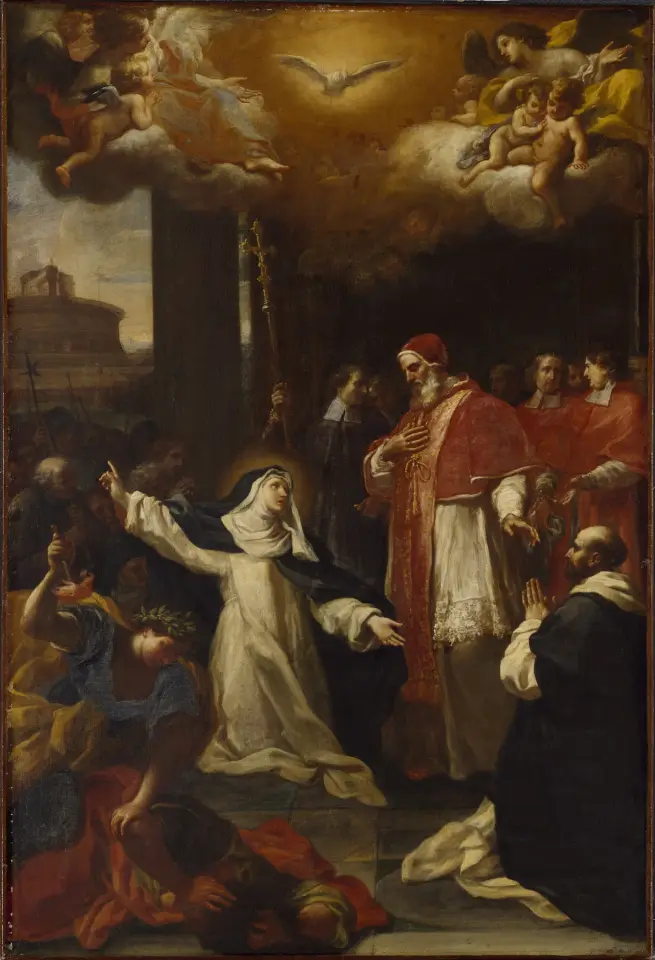
The papacy served French policy during the Hundred Years' War, alienating England and the empire. The ascetic Catherine of Siena had undergone a mystical "betrothal" to Christ. She waged an energetic letter campaign for the pope's return to Rome. On 17 January 1377 Gregory XI finally entered Rome, ending the Avignon period.
Key points
- Clement V's move to Avignon (1309) and the near-exclusively French College of Cardinals
- The destruction of the Templar order and the burning of Jacques de Molay (1307–1314)
- John XXII's system of church taxes and charges of simony
- Catherine of Siena's campaign and Gregory XI's return to Rome (17 January 1377)
- Shelley: in 1305 the Frenchman Clement V was elected and never reached Rome; six French popes settled at Avignon, where bureaucracy and a palace grew. Rome stood for apostolic succession, Avignon for a “French enclave”; in 1324 Louis of Bavaria opposed John XXII. The Avignon popes were disliked above all for how they squandered money: declining income from the Papal States brought the court to bankruptcy, and popes used old schemes and devised new ones. The annate was a new bishop's first-year income; popes often transferred a bishop from another city to collect more annates, and the right of reservation meant delaying an appointment to take the income for the whole period. The most profitable practice was indulgences, even for bridges and wars; claims for their spiritual benefits grew with each generation. Taxes were demanded under threat of excommunication; in 1360 unrest in the Papal States showed Avignon could not continue
- McGinn: Catherine of Siena was a visionary and a reformer in Italy’s church politics at Avignon and the Schism; the Dialogue was written in 1377–8
People
- Clement V
- John XXII
- Gregory XI
- Catherine of Siena
- Jacques de Molay
- Philip IV
Place
Avignon; Rome
Sources disagree
González (Story of Christianity, vol. I) sometimes gives '1309–1377' for the Avignon period (dating from Clement V's move to Avignon), while other books count from Clement V's election in 1305.
Sources
- Tony Lane – Christian Thinkers (Russian edition), p. 90, 137–139
- Justo L. González – The Story of Christianity, vol. I (Russian edition), Ch. 26, sec. 26.2
- J. North – A History of the Church (Russian edition), p. 200–203
- Justo L. González – A History of Christian Thought in One Volume (Abingdon, 2014), p. 259, 262
- Bruce L. Shelley – Church History in Plain Language (Russian edition), Ch. 22, sec. «Пленение Его Святейшества»
- The Oxford Handbook of Mystical Theology, ed. Edward Howells, Mark A. McIntosh (2020), Ch. 4, sec. «French and Italian Mysticism»
Data compiled: 2026-11-09