c. 318–325 · 4th century
The Beginning of the Arian Controversy: Arius and Alexander of Alexandria
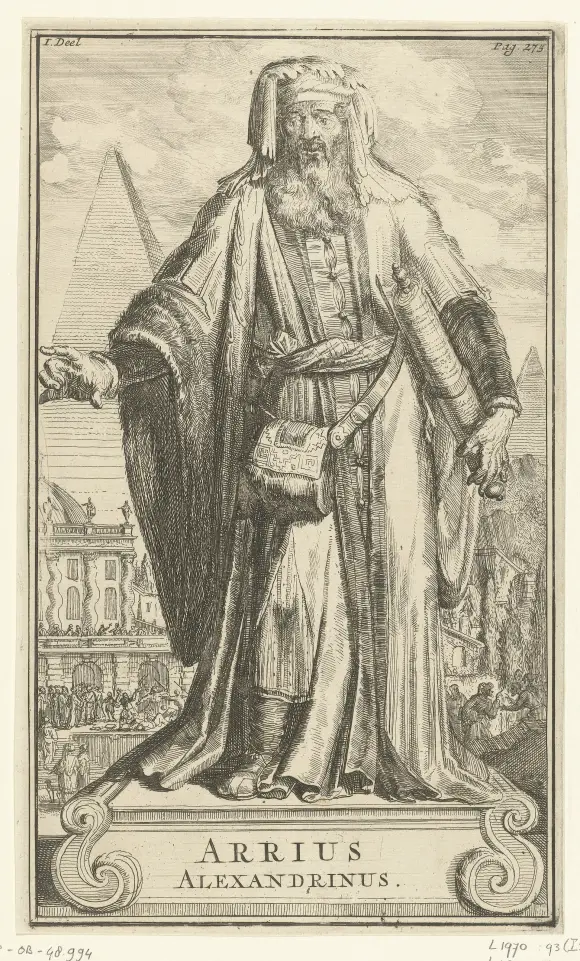
Arius, a presbyter of Alexandria, was formed by Origen's subordinationism and was apparently a student of Lucian of Antioch. He put forward a teaching of the Son as created and not of one substance with the Father. Bishop Alexander of Alexandria opposed him, supported by the deacon Athanasius. Alexander convened councils in Alexandria attended by up to a hundred bishops and circulated letters defending orthodoxy.
The excommunicated Arius found support among a number of "fellow Lucianists", chiefly Eusebius of Nicomedia and, in part, Eusebius of Caesarea. The dispute began as a local one but grew into a conflict engulfing the whole East. In early 325 a local council at Antioch pre-emptively condemned Arian formulas. This prepared the ground for the Council of Nicaea.
Key points
- Alexander's councils in Alexandria – up to 100 bishops
- The excommunicated Arius won the support of Eusebius of Nicomedia and the "fellow Lucianists"
- A local dispute grew into a conflict engulfing the whole East
- The Council of Antioch in early 325 condemned Arian formulas ahead of Nicaea
- Shelley: about 318 Arius in Alexandria declared the Word a lesser deity of a different nature: “the Son had a beginning, but God is without beginning”. Arius had a gift for publicity: his ideas were sung in verse across the city; after his condemnation (c. 320) riots began
People
- Arius
- Alexander of Alexandria
- Athanasius the Great
- Eusebius of Nicomedia
- Eusebius of Caesarea
- Hosius of Córdoba
Place
Alexandria, Antioch
Sources disagree
Books differ on the dating of the dispute's start: Pelikan gives c. 318–320, North gives 318, Hall gives c. 321–325; most simply place it "before 325".
Sources
- A. P. Lebedev – History of the Ecumenical Councils, part I, p. 17
- Louis Berkhof – History of Christian Doctrines (Russian edition), p. 55–57
- Jaroslav Pelikan – The Christian Tradition: A History of the Development of Doctrine, vol. 1 (Russian edition), p. 204–213
- J. North – A History of the Church (Russian edition), p. 70–71
- Stuart G. Hall – Doctrine and Practice in the Early Church (Russian edition), p. 82–85
- Justo L. González – A History of Christian Thought in One Volume (Abingdon, 2014), p. 115–116
- Tony Lane – Christian Thinkers (Russian edition), p. 35
- Bruce L. Shelley – Church History in Plain Language (Russian edition), Ch. 10, sec. «Осмысление тайны»
More on the doctrine
- Arius: the Son as a perfect creature, and Arian christology (c. 320–325)
- Sacraments in the 4th century: mystagogy, baptism, the Eucharist and the Trinitarian debates (4th century)
Data compiled: 2026-11-09