1910–1976 · 20th century
From fundamentalism to American neo-evangelicalism: "The Fundamentals," Carl Henry, Billy Graham
In 1910–1915 the American series "The Fundamentals" defended the inspiration of Scripture, Christ's deity, and other basics of the faith against liberalism. It laid the basis for an interdenominational conservative coalition.
In 1941–1942 conservatives split between the separatist American Council of Churches and the less radical National Association of Evangelicals. In 1947 Carl Henry's tract "The Uneasy Conscience of Modern Fundamentalism" rebuked fundamentalism for abandoning social responsibility. It gave rise to neo-evangelicalism, which kept the doctrine but dropped separatism.
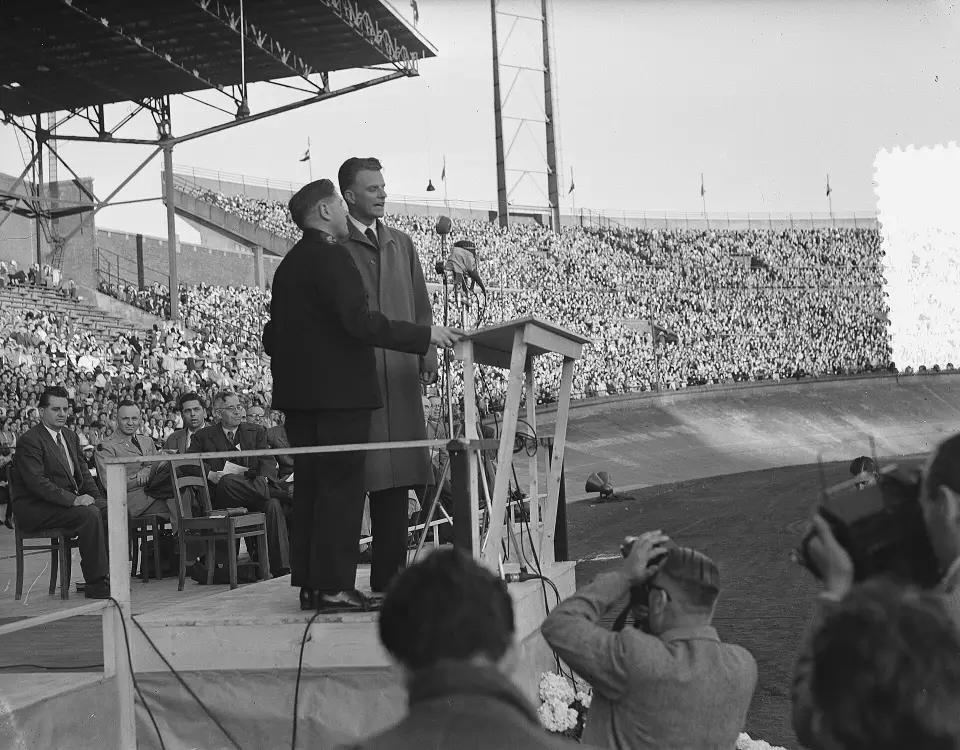
In 1949 Billy Graham began an international evangelistic ministry. In 1956 Carl Henry became founding editor of "Christianity Today." The magazine was launched with Graham's support as a conservative alternative to the liberal "Christian Century."
The movement styled itself a "third force" alongside Catholicism and the World Council of Churches. Meanwhile, the 1973 "Chicago Declaration" revealed a split among evangelicals over social responsibility.
Key points
- "The Fundamentals" (1910–1915) – the roots of fundamentalism
- 1941–1942 – the American Council of Churches and the National Association of Evangelicals
- 1947 – Carl Henry's "The Uneasy Conscience of Modern Fundamentalism," the birth of neo-evangelicalism
- 1949 – Billy Graham begins his ministry; 1956 – "Christianity Today" magazine founded
- 1973 – the "Chicago Declaration" on evangelical social responsibility
- Shelley: after WWII evangelical Christianity regained prominence, and its best-known voice was Billy Graham. He grew up in the Southern Baptist and Presbyterian tradition, studied at Bob Jones, Florida Bible Institute and Wheaton, and after a pastorate in Western Springs gave himself fully to ministry in Youth for Christ. After the widely publicized Los Angeles campaign (1949) Graham became famous and soon held crusades in cities worldwide; he preached to thousands in US stadiums, spoke on radio and television, and his magazine Decision reached millions of homes. Many conservatives disliked fundamentalism's interwar drift: they felt it stood on shaky ground and stressed the wrong things, though they did not criticize its doctrines. In 1956 Graham headed a group of evangelicals who began publishing the magazine Christianity Today; Carl Henry left his teaching post at Fuller Seminary to become its editor. The magazine was first mailed free to theologians and clergy of varied views, ensuring wide circulation; Henry wrote that it would tell this generation about historic Christianity, and the editors affirmed the Word of God's “full trustworthiness”. In 1976 Jimmy Carter’s evangelical faith became one of the chief issues of the campaign, though Arthur Schlesinger Jr. said closeness to God “means absolutely nothing in the campaign”. By the 1970s there were about 45 million evangelicals in the US: about a third came from the 36 million Protestants of the National Council of Churches (mainline, in Marty’s term “public” Protestants), about 33 million were outside the Council (“private” Protestants) – comparable to 46 million Catholics. This was not a single group – it included fundamentalists and Pentecostal-charismatics – and despite the growth the movement had little influence on government, universities and the media. By the late 1970s evangelicals worried whether their faith changed the moral climate of a country suffering from crime, divorce, racism and drugs. In 1979 Jerry Falwell, pastor of Thomas Road Baptist Church in Lynchburg, Virginia, founded the political group the Moral Majority and became the first prominent spokesman of the “religious right,” a coalition of fundamentalists, Pentecostals, evangelicals and Catholics alarmed by the decline of American morality. Its heart was a loose alliance: Robert Grant’s Christian Voice, Beverly LaHaye’s Concerned Women for America, Pat Robertson’s Freedom Council (Robertson was a televangelist and Republican presidential candidate in 1988). Televangelists were the mainstay: Falwell’s “Old Time Gospel Hour,” CBN and Robertson’s “The 700 Club,” Dobson’s radio “Focus on the Family”. Most important was that the groups mobilized fundamentalists and Pentecostals, previously politically inactive. Three issues mobilized them. In 1973 Roe v. Wade made abortion part of the right to privacy, which shocked many Catholics and Protestants: for many of these Christians life begins at conception. In 1978 conservative pastors in California opposed widening protection of homosexuals' rights; the IRS warned that politics endangered churches' tax status, and the pastors founded Christian Voice. The third was the fight over the Equal Rights Amendment: Falwell objected to its wording and fought its ratification in Virginia. From the mid-1960s the mainline Protestant churches (Episcopal, Methodist, Presbyterian and others) declined in membership and funding, while conservative Protestants generally flourished: the Pentecostal Assemblies of God grew from half a million to over four million. By 1990 there were 55 million Catholics in the US thanks to Latino growth, over a third of the Church in America. Of the three answers conservative churches gave to secularism, the first was the expectation of an imminent end of the age: Hal Lindsey’s bestsellers bred an expectation of Christ’s coming at any moment; such zeal even took on Gnostic overtones by devaluing creation, and after some decades, when Christ did not come, the movement lost strength. The third answer, the search for “relevance,” produced the megachurches: as denominations weakened and religion became private, large churches received a growing share of American churchgoers. They drop the denominational “label” (the sign says “chapel,” “center” or “community”); typical are fast, enthusiastic religious pop music and a charismatic preacher who applies the Bible to daily life; they give an impression of efficiency and prosperity, and historians see in this another example of the privatization of faith in America. Later hundreds of churches arose for the “postmodern generation”: feelings over linear thinking, experience over propositional truths, and shared worship valued over the loss of the individual in a crowd
- Holmes: the Cambridge student movement before 1920 (later UCCF) rivalled the SCM; after 1945 the Tyndale Fellowship united evangelical biblical scholars. In the 1950s Martyn Lloyd-Jones founded a Puritan conference and, against John Stott, urged leaving the historic denominations.
- George: “neo-evangelicalism” (Ockenga’s term): NAE (1942), Fuller (1947), Christianity Today (1956); motto “anchored to the Rock, but geared to the times”. Henry rejected the liberal social gospel, “all social and no gospel”, but appealed to the earlier evangelical consensus of social reform; in 1966 he co-chaired with Graham the Berlin World Congress on Evangelism, precursor of Lausanne 1974; God, Revelation and Authority came 1976–83. Younger evangelicals find Henry’s emphasis on propositional revelation and deductive theology inadequate for the postmodern situation. Carnell of Fuller called fundamentalism “orthodoxy gone cultic” and kept to inerrancy even after Fuller dropped it from its statement of faith. Oden moved from modern theology to “paleo-orthodoxy”; Andrewes’s formula: one canon, two testaments, three creeds, four councils, five centuries. Oden’s 27-volume Ancient Christian Commentary on Scripture put evangelicals in dialogue with the Great Tradition; he called for a “new ecumenism”. The Arminian Oden and the Calvinist Packer published One Faith: The Evangelical Consensus (2004), extracts from statements of faith since 1950. Packer took part in Evangelicals and Catholics Together (Colson, Neuhaus), exploring greater unity between Catholics and evangelicals in North America. In November 2003, amid a row over open theism, the Evangelical Theological Society voted to retain Pinnock in its membership.
- Frykholm: since c. 1980 American evangelicals have fought for political goals while arguing the US is doomed; their voting bloc reshaped Congress
People
- Benjamin B. Warfield
- James Orr
- Carl Henry
- Billy Graham
- Harold Ockenga
- Carl McIntire
- Edward J. Carnell
- Thomas C. Oden
- J. I. Packer
- Clark H. Pinnock
Place
USA
Sources
- Tony Lane – Christian Thinkers (Russian edition), p. 249–253
- Stanley Grenz, Roger Olson – 20th-Century Theology: God and the World in a Transitional Age (Russian edition), p. 435–450
- J. North – A History of the Church (Russian edition), p. 387, 402–403
- Justo L. González – The Story of Christianity, vol. II (Russian edition), Part 4, ch. 35, section «Послевоенные десятилетия»
- Justo L. González – A History of Christian Thought, vol. III: From the Protestant Reformation to the Twentieth Century (Abingdon, rev. ed. 1987), p. 468–469
- Bruce L. Shelley – Church History in Plain Language (Russian edition), Ch. 43, sec. «Возрождение евангельского христианства»; Ch. 43, sec. «Возвращение старой доброй религии»; «Возрождение евангельского христианства»; Ch. 46, sec. «Ответ евангеликов: спасение, исправление, уместность»; Ch. 46, sec. «Сдвиг в западном христианстве и церквях»; «Ответ евангеликов: спасение, исправление, уместность»
- The Cambridge Companion to Evangelical Theology, ed. Timothy Larsen and Daniel J. Treier (2007), p. 263–264, 264, 295, 296, 297, 300, 301, 302, 302–303, 299
- The Oxford Handbook of Apocalyptic Literature, ed. John J. Collins (2014), p. 461
Data compiled: 2026-11-09