31 October 1517 · 16th century
Luther's Ninety-Five Theses on indulgences
The Dominican Johann Tetzel was selling indulgences for Archbishop Albrecht of Brandenburg with the permission of Pope Leo X. Outraged by this, Luther drew up in Latin a "Disputation on the Power and Efficacy of Indulgences" – 95 theses. By tradition, he posted them on the door of the Wittenberg castle church on 31 October 1517.
It was originally an academic challenge to scholarly debate. It was aimed at preachers of indulgences rather than the pope himself. Luther's doctrine of justification by faith already removed the very need for indulgences.
Without the author's knowledge the theses were translated into German, printed and spread across Germany. This made Luther a popular hero. The date is conventionally taken as the start of the Reformation.
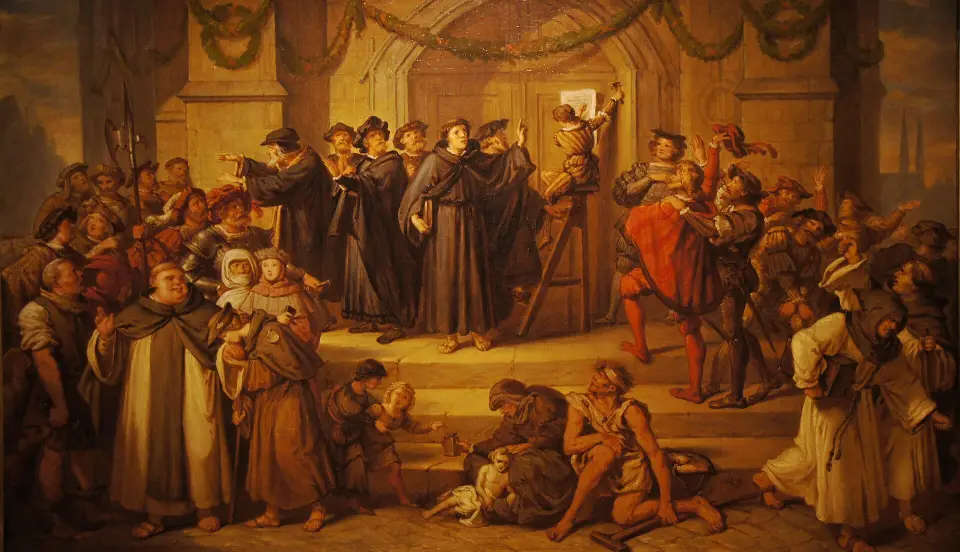
Key points
- Earlier, in September 1517, Luther had already put forward 97 theses against scholastic theology, which went almost unnoticed
- Thesis 82, among the "keen questionings of the laity" (thesis 81): why does not the Pope empty purgatory "for the sake of most holy charity", if he redeems countless souls for money to build a basilica?
- Half the proceeds from indulgences went toward building St Peter's in Rome
- Frederick the Wise of Saxony protected Luther from prosecution
- Hendrix: the 95 Theses questioned not only indulgence abuses but their value and the pope’s power over souls in purgatory: those who think indulgences make them safe will neglect contrition, trust in absolution and works of satisfaction, and “will be damned” (thesis 32). Luther called the Gospel the Church’s true treasure (thesis 62) and urged Christians to follow Christ through punishment, death and hell (thesis 94).
- Bagchi: the first replies to the Ninety-five Theses came from those closest to the matter: Johann Tetzel, indulgence preacher and papal inquisitor, his mentor Konrad Koch (“Wimpina”) of Frankfurt-on-Oder and the papal courtier Sylvester Prierias. Tetzel and Prierias, charged with the preliminary investigation, recast the attack on indulgences as an attack on papal authority.
- Shelley: in 1517 the Dominican Tetzel, raising funds for St Peter’s, promised indulgences valid even beyond death (‘as the coin rings…’). On 31 October Luther nailed the 95 theses to the Castle Church door: indulgences remove no guilt, do not apply to purgatory and breed false security. Dominicans denounced Luther to Rome, counter-theses called any indulgence critic a heretic, and Luther would yield if shown errors from Scripture.
- Mattox: the 95 Theses were probably not nailed to a door; they were printed without Luther’s leave, and the first thesis says that the whole life of believers should be penitence. Leo X approved the indulgence for Albrecht of Brandenburg, who owed Rome 21,000 ducats borrowed from the Fuggers.
People
- Martin Luther
- Johann Tetzel
- Leo X
- Albrecht of Brandenburg
- Frederick the Wise
- Cajetan
Place
Wittenberg
Sources
Primary sources
- Luther – Disputation on the Power and Efficacy of Indulgences (95 Theses), theses 1, 32, 62, 81–82, 94
Textbooks
- Alister McGrath – Reformation Thought (Russian edition: «Theological Thought of the Reformation»), p. 14, 47, 151
- Justo L. González – A History of Christian Thought in One Volume (Abingdon, 2014), p. 283–284
- J. North – A History of the Church (Russian edition), p. 240
- Justo L. González – A History of Christian Thought, vol. III: From the Protestant Reformation to the Twentieth Century (Abingdon, rev. ed. 1987), p. 35–38
- Tony Lane – Christian Thinkers (Russian edition), p. 158–159, 163
- Justo L. González – The Story of Christianity, vol. II (Russian edition), Part 1, ch. 2
- The Cambridge Companion to Reformation Theology, ed. David Bagchi, David C. Steinmetz (2004), p. 54, 232
- Bruce L. Shelley – Church History in Plain Language (Russian edition), Ch. 24, sec. «Лютер и папская власть»
- The Oxford Handbook of Sacramental Theology, ed. Hans Boersma, Matthew Levering (2015), p. 328–329, 329
Data compiled: 2026-11-09