1378 · 14th century
Wyclif: Scripture above Tradition, Councils and Popes; Condemnation at Constance
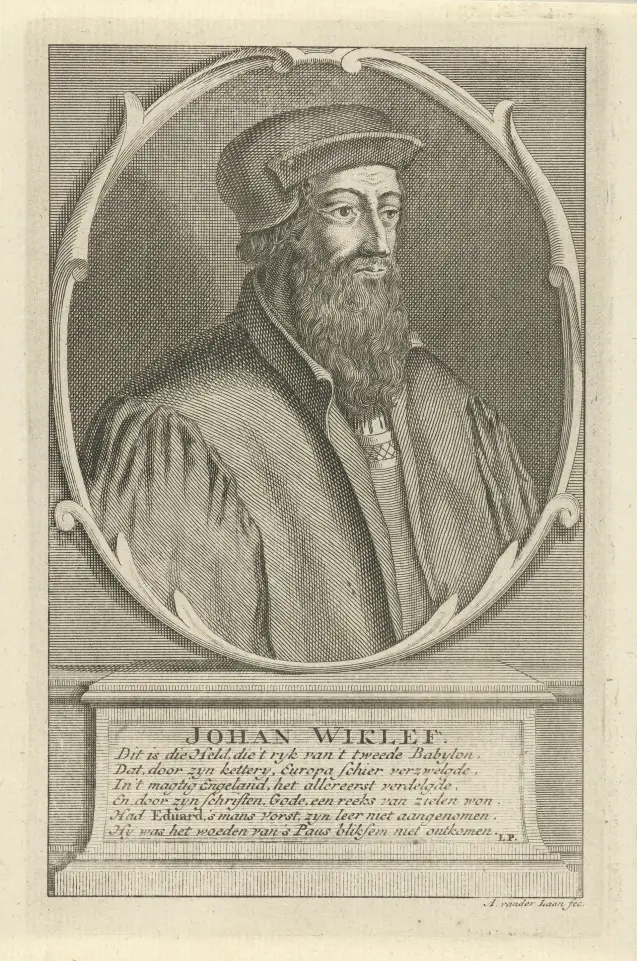
At first Wyclif accepted the Church and tradition as guides for interpreting Scripture, but he became increasingly convinced that much in "Christian tradition" contradicted the Bible. In On the Truth of Holy Scripture (1378) he called the Bible the supreme standard by which the church, tradition, councils and even popes must test their actions. Scripture contains everything necessary for salvation and is given to the faithful people, not as a monopoly of the clergy; hence the translation of the Bible into English and the "poor preachers." In 1415 the Council of Constance condemned Wyclif's propositions and burned Jan Hus, and in 1428 Wyclif's remains were dug up and burned.
Positions
- Catholic tradition (according to Lane)
- The authority of tradition, councils and popes
- Wyclif
- Scripture is the supreme standard; reason and revelation do not contradict each other, since they lead to one truth
Key points
- Lane: Wyclif was the first to move from criticism of rites and abuses to criticism of the doctrines of the Catholic Church; 45 of his propositions were condemned. The Lollards spread the English Bible and rejected the Roman church; after the rising of 1414 the movement went underground. Wyclif and Hus, rejecting pope and council in the name of Scripture, became forerunners of the Reformation; their view of justification is unclear
- González: more than two hundred of Wyclif's propositions were condemned; Hus was deeply influenced by Wyclif but more moderate in expression
- Scase: Wycliffe’s contemporaries held the authority of scripture to be the centre of his thought and nicknamed him Doctor Evangelicus; on scripture he based his critique of eucharistic theology, hierarchy and clergy, and any humble heart, even a layperson or woman, might interpret it
- Shelley: Wycliffe judged the Church by Scripture: Augustine and Jerome are not accepted unless grounded in Scripture; “the law of Christ is sufficient”. He held the New Testament clear to simple people in all needed for salvation, and so affirmed everyone’s right to study the Bible himself
Outcome
Wyclif's views were repeatedly condemned by the pope and the English bishops, and then by the Council of Constance; the Lollard movement prepared the ground for the English Reformation.
People
- John Wycliffe
- Jan Hus
Place
Oxford, Lutterworth, Constance
Sources disagree
On the Truth of Holy Scripture – 1378 (Lane); Wyclif's dates – c. 1329–1384 (González). Condemnation at Constance – 1415, burning of the remains – 1428. Number of condemned propositions: Lane – 45, González – more than two hundred.
Sources
- Justo L. González – A History of Christian Thought in One Volume (Abingdon, 2014), p. 266–267, 269
- Tony Lane – Christian Thinkers (Russian edition), p. 137–139
- The Cambridge Companion to Reformation Theology, ed. David Bagchi, David C. Steinmetz (2004), p. 30
- Bruce L. Shelley – Church History in Plain Language (Russian edition), Ch. 23, sec. «От реформатора к протестанту»
Related entries
- Developed in: Luther: The Word of God and the Primacy of the Gospel over Tradition (Leipzig Disputation, 1519) (1519)
In church history
- John Wycliffe and the Lollards (c. 1330–1428)
Data compiled: 2026-11-17