1965 · 20th century
The Second Vatican Council: The Constitution on Divine Revelation (1965)
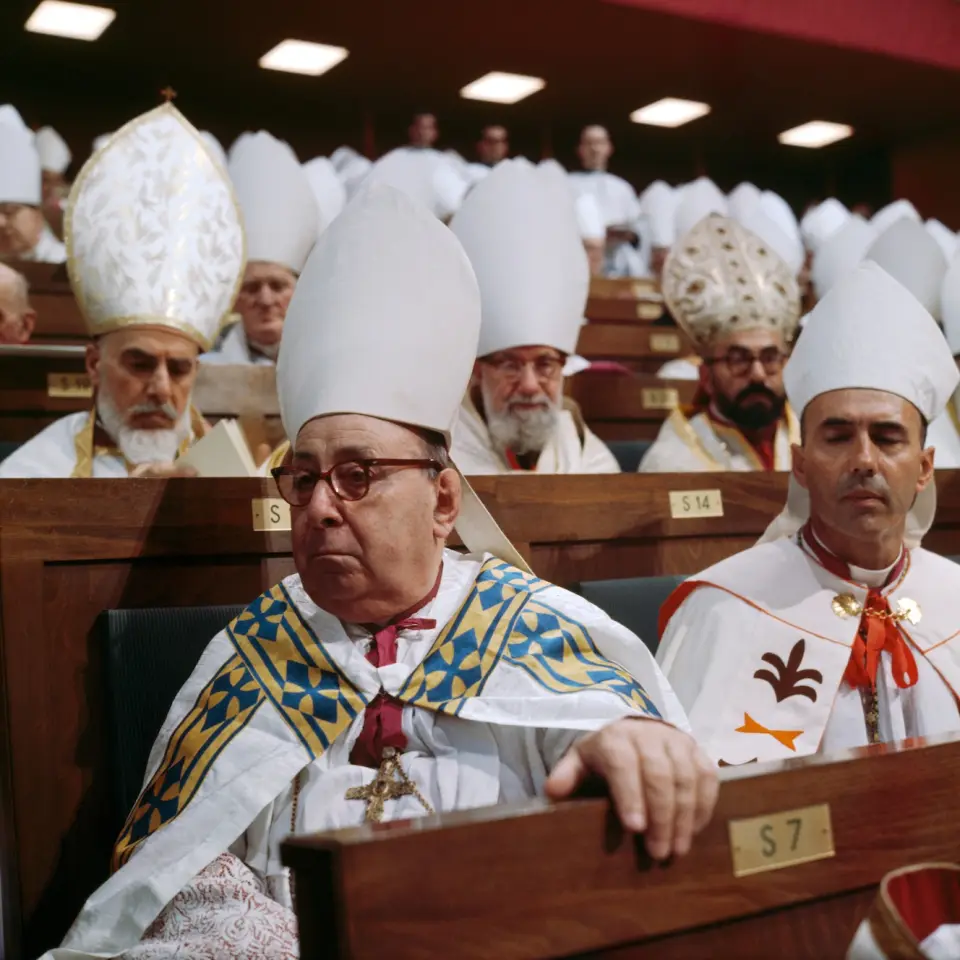
The Constitution on Divine Revelation provoked a fierce struggle between conservatives and progressives: the first, ultraconservative draft was rejected by more than 60% of the council fathers, and the final document was adopted by 2,344 votes to 6. Revelation is understood as the manifestation of God himself through inwardly connected deeds and words, and Christ as the Mediator and fullness of revelation. The Gospel is the sole source of saving truth, transmitted in two ways: through tradition and Scripture; the council took steps to avoid saying that tradition adds anything to Scripture and referred to Newman's teaching on development. The laity are urged to read the Bible and Catholics to cooperate with Protestants in translation, but the final norm remains the judgment of the infallible church, whose teaching office "is not above the Word of God but serves it."
Positions
- Conservatives (first draft)
- Revelation as the manifestation of doctrines; tradition and Scripture as two sources of revelation; tradition as an addition; the "absolute immunity" of Scripture from error
- The council
- Revelation is God himself; Scripture and tradition transmit the one Gospel; the final judge is the church
- Paul VI
- At his demand the words were added at the last moment: "It is not from sacred Scripture alone that the Church draws her certainty about everything that has been revealed"
Key points
- Pope John XXIII sent the first text back to committee for revision; there were five drafts in all
- "The Church is always advancing toward the fullness of divine truth until the words of God reach their complete fulfillment" – a reference to Newman's doctrine of development
- The books of Scripture “teach firmly, faithfully and without error the truth which God, for the sake of our salvation, wished to see confided”
- Lane: this formulation allows many interpretations
- "Ignorance of the Scriptures is ignorance of Christ" (Jerome); "the study of the sacred page is the soul of sacred theology"
Outcome
The Second Vatican Council, according to Lane, gave the Bible new rights while leaving the final interpretation to the church.
People
- John XXIII
- Paul VI
- John Henry Newman
- Jerome
Terms
- economy of revelation
- Revelation takes place through deeds and words that are inwardly connected.
- tradition
- According to the council, a very broad term: the church preserves and hands on all that it is and all that it believes.
Place
Rome
Sources disagree
Adopted in 1965; according to Lane, work on the constitution took three years after the first draft.
Sources
- Tony Lane – Christian Thinkers (Russian edition), p. 304–306
Related entries
- Develops: The Oxford Movement: tradition, apostolic succession and the development of doctrine (1833–1845)
In church history
Data compiled: 2026-11-17