428–431 · 5th century
Nestorius and the dispute over the title "Theotokos"
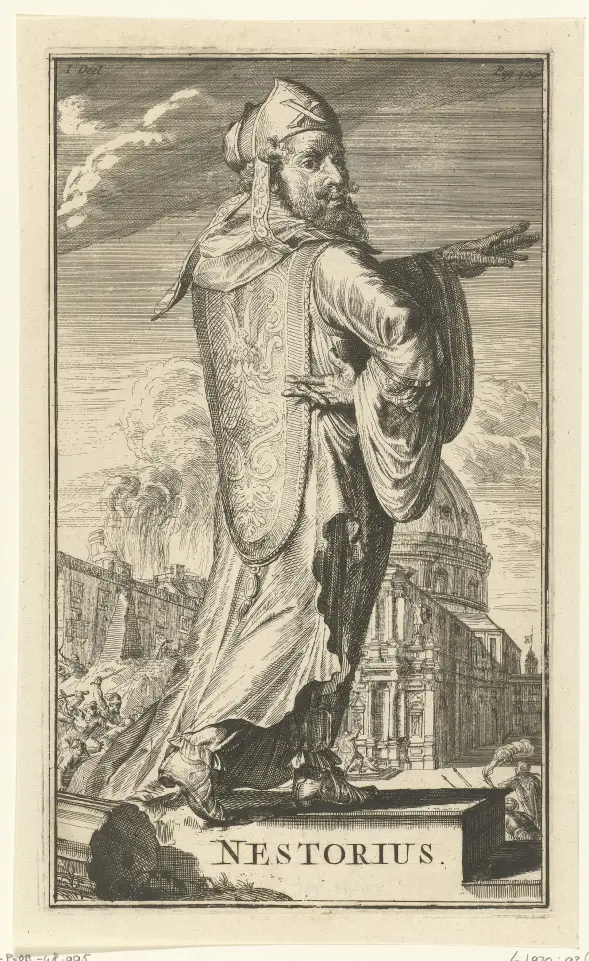
In 428 the Antiochene Nestorius, a disciple of Theodore of Mopsuestia, became bishop of Constantinople and spoke out against the title "Theotokos" for Mary: the man Jesus was born of Mary, but not God the Word, and she may be called "Christotokos" (so too in his reply to Cyril: "according to the most accurate terminology" the virgin is "Christ-bearer", not "God-bearer", par. 7). For Nestorius the union of natures is a "conjunction" in which each keeps its own predicates, so he did not accept the exchange of properties and saw in "Theotokos" a mixing of the natures. Cyril of Alexandria held that denying the title destroys the incarnation and redemption; opponents declared that Nestorius, like Paul of Samosata, made Christ an ordinary man. The Book of Heraclides, found in the 20th century, led to a reassessment: according to Hall, most 20th-century theologians recognized Nestorius as orthodox and his teaching as consistent with Chalcedon.
Positions
- Theodore of Mopsuestia
- "Christotokos" is more correct; if "Theotokos" is used, "Anthropotokos" should be added; the Word is not touched by sufferings
- Nestorius
- Mary is Christotokos; I distinguish the natures but unite the worship; otherwise the natures are mixed
- Cyril of Alexandria
- Denying "Theotokos" destroys the Incarnation and redemption; the title follows from the exchange of properties
- Berkhof
- In Nestorianism the two natures become two persons joined only by a moral union
Key points
- González: the dispute was not simply about Mary but about the person and work of Christ; Nestorius was vulnerable because he attacked a title rooted in worship and piety
- Pelikan: Nestorius preferred "Christotokos" but did not reject the name definitively
- Lane: the clash cannot be regarded merely as an ecclesiastical-political struggle between Alexandria and Constantinople
- Hall: in his reply to Cyril, Nestorius reads the Nicene Creed in the Antiochene way: first the one Christ, then the two natures (par. 3: the names shared by divinity and humanity – "Lord Jesus Christ", "only-begotten", "Son" – are first placed as foundations, then upon them is built the tradition of incarnation, suffering and resurrection); God did not suffer and die (pars. 2, 6)
- Lebedev: the Nestorians are “the Arians of the 5th century”: Nestorius described the union of the natures as “contact” (συνάφεια). Regions divided as in the Arian era: Alexandria, Rome, Jerusalem, Illyricum against Nestorius, Antioch, Constantinople, Asia for him
- Daley: in the First Sermon against the Theotokos Nestorius places Jesus' person and work within God's general providence: God, “untouched by change” yet “benevolent and just,” took up the man Jesus to “bring about the revival of the human race”. God cannot be born or die, but the man assumed by the Word is his “temple” and “instrument of his godhead”. The human “person” (πρόσωπον) assumed by the Son pays our nature's debt to God and pleads against the devil, who had accused it since Adam: “our nature, put on by Christ like a garment, intervenes for us … to dissolve by the flesh the corruption that arose by the flesh”. The very difference between deity and humanity in Christ makes possible his uniquely exalted position as Savior. In the Book of Heracleides (430s–440s) Nestorius builds a Christology of “union by πρόσωπον” to clear himself of teaching “two Sons”: the Word and the man confer their “faces” on each other and so “form” each other; the Word shapes the man Jesus into one who reveals God, and Jesus gives the Word human words and a human face. Nestorius rejected union “in substance” or “in nature”: it would subject the Word to change and suffering and make Jesus' humanity incomplete, a mere appearance; “it is a voluntary union in πρόσωπον and not in nature”. Nestorius most feared compromising God's transcendent qualities – impassibility, unchangeability, freedom
- Shelley: Nestorius did not divide Christ into two sons but refused to ascribe human deeds and sufferings to the divine nature: “I divide the natures but unite the worship”. To call Mary Theotokos would, for him, mean the divine nature was born of a woman or God was three days old; in his autobiography Nestorius insisted he objected to stress Jesus' truly human birth, with body and soul. Nestorius' concern was well founded; the Church, however unjustly, ascribed to him an inability to see the two natures as truly one, and it remains unclear how heretical his teachings were and how far he fell victim to misunderstandings. Some recent views of Christ are Nestorian: if Jesus’s tie to the Word rested on his will, he is only an example; Shelley regrets that some evangelicals seek in Jesus a role model and miss the transformation Immanuel gives
Outcome
The dispute turned into open confrontation between Cyril and Nestorius and led to the convening of the Council of Ephesus; the assessment of Nestorius as a heretic has, according to Hall, been revised in recent scholarship.
People
- Nestorius
- Theodore of Mopsuestia
- Cyril of Alexandria
- Proclus
Terms
- Theotokos – θεοτόκος
- She who gave birth to God, the Bearer of God; for Athanasius, denying the title would be denying the incarnation of the Word.
- Christotokos – χριστοτόκος
- She who gave birth to Christ; Theodore's term, preferred by Nestorius.
- conjunction
- Nestorius's understanding of the union of natures in Christ.
Place
Constantinople
Sources disagree
All books: Nestorius was bishop of Constantinople from 428 (González: early 428); Hall links the background of the dispute to 412, when Cyril became head of the Alexandrian church. The Book of Heraclides was found, according to Lane, in 1910. Lebedev: councils in Alexandria and Rome condemned Nestorius in 430.
Sources
Primary sources
- Nestorius – Reply to Cyril's Second Letter, para. 2–7
Textbooks
- Stuart G. Hall – Doctrine and Practice in the Early Church (Russian edition), p. 137–140, 142–143
- A. P. Lebedev – History of the Ecumenical Councils, part I, p. 131–145, 311
- Jaroslav Pelikan – The Christian Tradition: A History of the Development of Doctrine, vol. 1 (Russian edition), p. 252–257
- Louis Berkhof – History of Christian Doctrines (Russian edition), p. 70–71
- Justo L. González – A History of Christian Thought in One Volume (Abingdon, 2014), p. 157–158
- Tony Lane – Christian Thinkers (Russian edition), p. 58–59
- The Oxford Handbook of Christology, ed. Francesca Aran Murphy (2015), p. 165, 170–171, 171–172
- Bruce L. Shelley – Church History in Plain Language (Russian edition), Ch. 11, sec. «Главные ереси об Иисусе»
Related entries
- Develops: "Logos-man" and "Logos-flesh": the Antiochene and Alexandrian christologies (4th–5th centuries)
- Answered by: Cyril of Alexandria, the Council of Ephesus (431) and the Formula of Union (433) (431–433)
In church history
- The Nestorian controversy and the Third Ecumenical Council of Ephesus (431); the Union of 433 (428–431 (council – June 431); union of 433 (established by 437–438))
Data compiled: 2026-11-17