1147–1151 · 12th century
Peter Lombard, The Four Books of Sentences
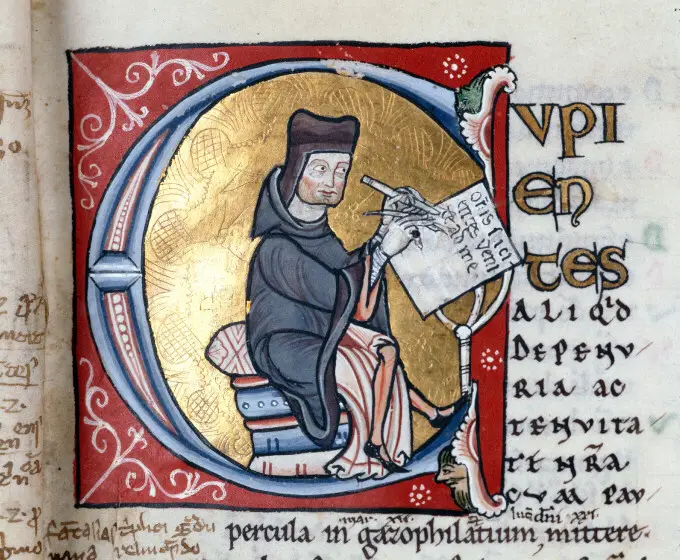
The Sentences are a collection of excerpts from the Bible, the Fathers and other authorities in four books: on God; on creation, grace and sin; on Christ and the virtues; on the sacraments and eschatology. The method resembled Abelard's but was combined with respect for authorities, so the Lombard won Bernard's support; unlike Abelard he added his own, usually moderate, opinions. The work's significance, according to González, lies not in originality but in having avoided the extremes of the dialecticians and anti-dialecticians and in providing an abundance of material. The Sentences became the standard textbook, and a commentary on them a requirement for the doctorate.
Key points
- The aim was not new ideas but determining the truth on the basis of authorities ("dwarfs on the shoulders of giants")
- González: the Sentences are the culmination of 12th-century theological work and its chief legacy to the 13th century
- Sometimes the Lombard refrains from a verdict
- Wawrykow: the Lombard (Sent. III, d.6) sets out three opinions on the union of natures: homo assumptus, subsistence and habitus; they framed Western scholastic Christology; the third was later condemned and most inclined to the second
Outcome
The basis of scholastic education until the Reformation and beyond; according to González, the Sentences were displaced by Thomas's Summa only by the late 16th – early 17th century.
People
- Peter Lombard
- Peter Abelard
- Bernard of Clairvaux
Place
Paris
Sources disagree
Lane: 1147–1151; González does not date the work (the Lombard in Paris from c. 1130, bishop from 1159).
Sources
- Justo L. González – A History of Christian Thought in One Volume (Abingdon, 2014), p. 223–224
- Tony Lane – Christian Thinkers (Russian edition), p. 116–117
- The Oxford Handbook of Christology, ed. Francesca Aran Murphy (2015), p. 294–295
Related entries
In church history
- Peter Lombard's 'Sentences' and the Rise of the Universities (1090s–mid-13th century)
Data compiled: 2026-11-17