848–855 · 9th century
The Gottschalk Controversy over Double Predestination
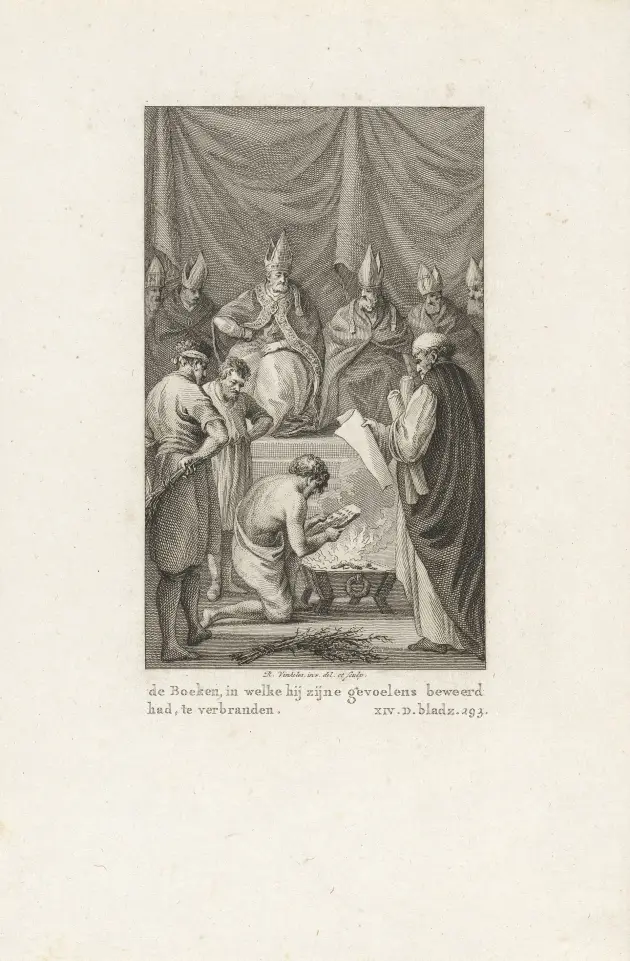
One of the sharpest theological controversies of the Carolingian era broke out between the monk Gottschalk of Orbais and his opponents, Rabanus (Hrabanus) Maurus and Hincmar of Reims. Drawing on Augustine, Ambrose, Gregory, Prosper and Fulgentius, Gottschalk taught that God predestined the angels and the elect to salvation and the demons and the reprobate to damnation; free will is so corrupted that it is incapable of good, and Christ died only for the elect. His opponents accused him of making God the author of sin; in 848 at Mainz he was condemned, flogged and imprisoned for life. Prudentius, Ratramnus and Remigius defended his teaching; the synod of Quierzy (853) expressed the views of his opponents, the synod of Valence (855) those of his defenders.
Positions
- Gottschalk, Prudentius, Ratramnus, Remigius
- Double predestination – to salvation and to perdition; sin is the object of a permissive decree; Christ died only for the elect
- Rabanus Maurus, Hincmar of Reims
- Predestination is only to life; the strict doctrine makes God the author of sin
Key points
- Berkhof: Gottschalk denied predestination based on foreknowledge; the dispute itself was little more than a quarrel over words: both sides were Semi-Augustinians and feared that a strict theory would rob the sacraments of their value
- González: Gottschalk understood Augustine more clearly than his opponents but expounded him so harshly that the teaching lost Augustine's tone of gratitude
- Valence: election is mercy preceding merits; in reprobation evil deeds precede just judgment
- Pelikan: both sides appealed to Augustine
Outcome
Gottschalk was condemned at Mainz (848); the synods of Quierzy (853) and Valence (855) adopted conciliatory formulas.
People
- Gottschalk of Orbais
- Rabanus Maurus
- Hincmar of Reims
- Prudentius
- Ratramnus of Corbie
- Remigius of Lyon
Terms
- double predestination
- The predestination of some to eternal life (salvation) and others to eternal death (perdition).
Place
The Frankish kingdom: Mainz, Quierzy, Valence
Sources disagree
Dates per Berkhof (Mainz 848, Quierzy 853, Valence 855); González dates the controversy only to the 9th century.
Sources
- Louis Berkhof – History of Christian Doctrines (Russian edition), p. 101
- Justo L. González – A History of Christian Thought in One Volume (Abingdon, 2014), p. 204–205
Related entries
- Developed in: For whom did Christ die: limited atonement from Gottschalk to Dort, Westminster and Owen (1618–1733)
In church history
Data compiled: 2026-11-17