1559–1647 · 16th century
England: royal supremacy, Hooker and Puritan models of the Church
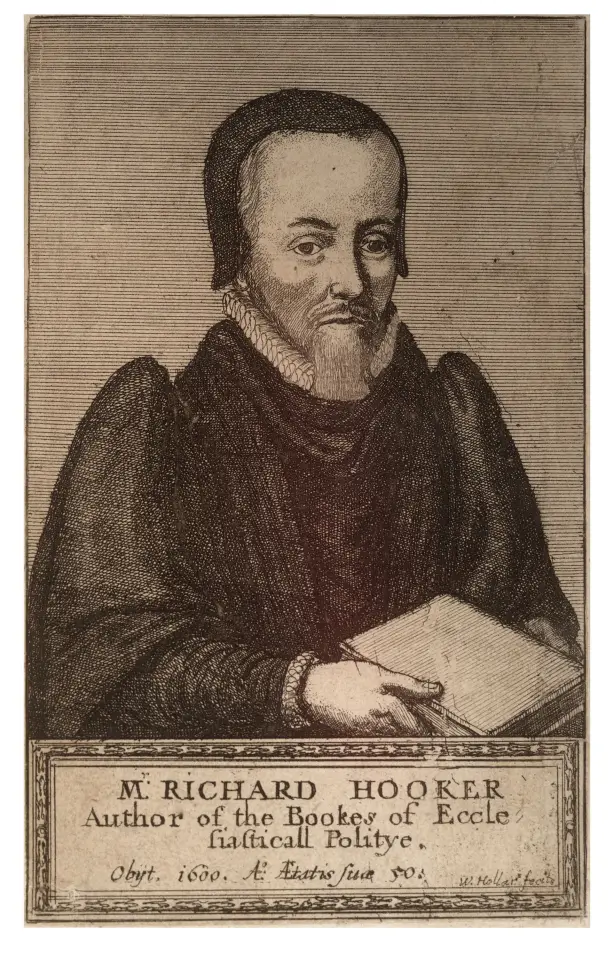
The Acts of 1534 declared Henry VIII supreme head of the Church in his dominions; the changes concerned authority, not doctrine. The Elizabethan Settlement (1559) permitted only the Church of England, and article 34 of the Thirty-Nine Articles gave "every particular or national Church" authority "to ordain, change, and abolish" rites ordained only by man's authority – in practice the right passed to the civil authorities. The English reformers rejected apostolic succession as the criterion of authority ("succession of doctrine," Jewel), but the state church kept control over ordination. Hooker, in Of the Laws of Ecclesiastical Polity, taught that church and state are one society with different functions, and that the criteria of polity are Scripture, tradition and reason. The Puritans held the Bible to be a complete guide to church life and divided into Presbyterians, Congregationalists and Baptists, the last understanding the Church as an assembly of believers under covenant, free from the state.
Positions
- Hooker
- Whatever does not contradict Scripture is permissible; church laws rest also on reason and tradition; the absence of the episcopate is no reason to reject the Reformed churches
- The Puritans
- The only criterion is obedience to the Word of God; only ceremonies mentioned in Scripture are allowed; presbyterianism or congregationalism
- The "high church" (Laud)
- Episcopacy is the only divinely instituted form of government
- The Baptists
- The Church is a voluntary assembly of believers; baptism only for those who profess faith
Key points
- McGrath: the English Reformation did not require doctrinal self-definition; doctrine was muted for the sake of the Church's unity
- González: some Puritans held that the state too exists as a covenant; this trait could justify a change of government and "cost Charles I his head". In 1581 Robert Browne founded at Norwich the first Congregationalist church in England – the beginning of separatism
- Lane: by the Westminster Confession (25:1–2) the catholic church is invisible and consists of all the elect, while the visible church is all who profess the true religion with their children, outside which there is "no ordinary possibility of salvation" (25:2). The Independents (Savoy Declaration, 1658) upheld the autonomy of the local church; the First London Baptist Confession (1644) rejected infant baptism: baptism is to be dispensed upon persons professing faith (art. 39)
- Trueman: church order under Edward VI was Erastian and episcopal, defined by the prayer books of 1549 and 1552. Hooper disputed with Cranmer over vestments and the oath by saints; for him what Scripture does not command in worship is idolatry. Knox in his Newcastle sermon (1550): all worship invented by man is idolatry; the mass is so invented, hence idolatry and abomination. This logic leaves no room for staged reform or adiaphora and underlies Puritan discontent with the English settlement. Knox objected to compulsory kneeling, and the “Black Rubric” was inserted in the 1552 prayer book: kneeling is not adoration of the elements; the rubric is Knox’s chief contribution to the English Reformation, dropped from later editions and restored in 1662
- Steinmetz: Anglicans kept the order of bishops, priests and deacons, but the dispute with critics produced the Puritan party and dissenters’ exit; not all Anglicans held bishops essential to the church’s esse, but they were convinced bishops belong to its bene esse
- Shelley: under the Act of Supremacy the king could appoint bishops but not ordain them; Elizabeth changed Supreme Head to Supreme Governor. A Church headed by a bishop is easier to govern, so the liturgy kept apostolic succession; Henry made the Church national
Outcome
Hooker became the chief defender of the Anglican settlement; the attempt to impose the prayer book on Scotland led to civil war and the Westminster Assembly, and after the Restoration of 1660 the episcopal system and the persecution of dissenters returned (Lane).
People
- Henry VIII
- Elizabeth I
- John Jewel
- John Hooper
- Richard Hooker
- Robert Browne
- William Laud
- John Owen
- John Knox
- Nicholas Ridley
Terms
- Scripture, tradition, reason
- Hooker's three criteria of church polity.
- Puritans
- Those who sought to purge the church of all unbiblical beliefs and practices.
Place
England, Scotland
Sources disagree
González: the Acts in 1534; McGrath and Lane: the Settlement in 1559; González: the Thirty-Nine Articles in final form in 1571, Hooker 1554–1600; Lane: the Westminster Confession in 1647.
Sources
Primary sources
- Thirty-Nine Articles of Religion, art. 34
- Westminster Confession of Faith, ch. 25, art. 1–2
- First London Baptist Confession (1644), art. 39
Textbooks
- Justo L. González – A History of Christian Thought in One Volume (Abingdon, 2014), p. 370–371
- Justo L. González – A History of Christian Thought, vol. III: From the Protestant Reformation to the Twentieth Century (Abingdon, rev. ed. 1987), p. 185–187, 192–194, 198–200, 297–300
- Alister McGrath – Reformation Thought (Russian edition: «Theological Thought of the Reformation»), p. 34–36
- Tony Lane – Christian Thinkers (Russian edition), p. 200–202, 205, 207, 209–210
- The Cambridge Companion to Reformation Theology, ed. David Bagchi, David C. Steinmetz (2004), p. 179–181, 181–182, 182–183, 181–183, 253
- Bruce L. Shelley – Church History in Plain Language (Russian edition), Ch. 27, sec. «Разрыв Англии и Рима», «Уклон в протестантизм»
In church history
Data compiled: 2026-11-17