1378–1417 · 14th century
Conciliarism: the authority of the council over the pope
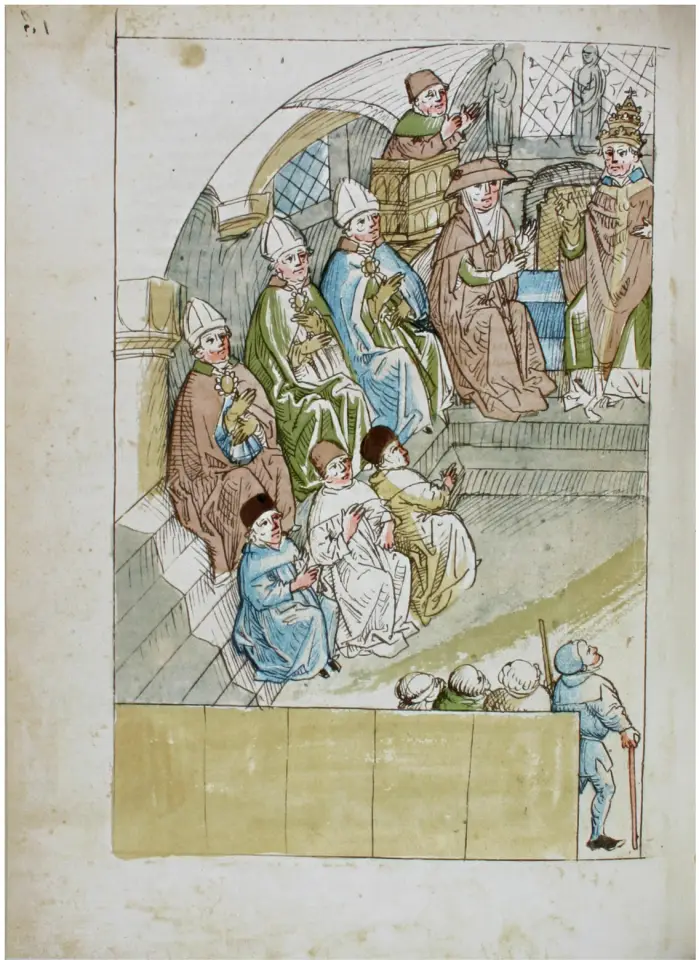
During the Great Western Schism (1378–1417), when the West was divided between two and at times three popes, the conciliar movement gained strength: a council representing the whole Church should determine the lawful pope, heal the schism, reform the Church and put an end to heresy. González links conciliarism with nominalism: the reality of the Church lies not in an eternal idea or in the hierarchy but in the believers themselves as a corporate body. Ockham held that supreme authority belongs to the general assembly, including laypeople, that the pope has no temporal power, and that the emperor may depose him. Marsilius of Padua carried these ideas to the conclusion that the Church should have no jurisdiction over the state and that power in the state belongs to the people.
Positions
- Conciliarists
- Supreme doctrinal authority belongs to the ecumenical council; the council may depose the pope or determine the lawful one
- Curialists
- Supreme doctrinal authority belongs to the pope personally
- Ockham
- The council is not infallible; the truth of faith may be upheld even by laypeople reading the Bible with humility
Key points
- González: the roots of conciliarism also include canon law, which had long allowed for a heretical or schismatic pope, and criticism of the wealth of the curia
- Ockham taught that civil power is instituted by God just as church power is, and contributed to the growth of the theory of the independent state
- McGrath: the Council of Constance set aside all three claimants, elected Martin V and condemned Jan Hus; the principle of councils’ authority over the pope seemed established, but Martin V thought otherwise. The failure of conciliarism was one of the main causes of the Reformation; in 1520 Luther recognized the princes' right to convene a reforming council
- Shelley: in 1326 Marsilius of Padua and John of Jandun in Defensor Pacis presented the Church as the community of all believers without priestly superiority; in this theory the papacy became the executive organ of a general council, and conciliarism soon found a place in practice. In 1409 cardinals of both camps at the Council of Pisa deposed the two claimants and elected Alexander V, but neither of the deposed submitted, and there were three popes. In 1414 the emperor called the grandest council of the age at Constance, with representatives of the Greek Church; for the first time nations voted (Germans, Italians, French, English, Spanish), and laymen were admitted. In 1417 the council accepted one pope’s resignation, deposed two and elected Martin V, who accepted only the decree that elected him. Constance decreed that general councils stand above popes and must be held periodically. The pope called this heresy, and in 1450 the papacy declared conciliarism untenable. Yet it could not be forgotten: estrangement from the pope grew, people thought of “national Churches,” and the ground for the Reformation was ready
Outcome
The Council of Constance ended the schism, but the question of who holds final doctrinal authority, according to McGrath, remained open and deepened theological confusion on the eve of the Reformation.
People
- William of Ockham
- Marsilius of Padua
- Martin V
- John XXII
- Louis of Bavaria
Terms
- conciliarism
- The theory of the supreme authority of the ecumenical council.
- curialism
- The theory of the supreme authority of the pope.
Place
Constance, Munich, Avignon
Sources disagree
The Great Schism: González and McGrath – 1378–1417, Lane – 1378–1414; Ockham's dates c. 1280–1349, Marsilius' c. 1275–1342 (González).
Sources
- Justo L. González – A History of Christian Thought in One Volume (Abingdon, 2014), p. 259–260, 262–265
- Alister McGrath – Reformation Thought (Russian edition: «Theological Thought of the Reformation»), p. 52–54
- Tony Lane – Christian Thinkers (Russian edition), p. 130–132
- Bruce L. Shelley – Church History in Plain Language (Russian edition), Ch. 22, sec. «Пленение Его Святейшества»; Ch. 22, sec. «Избрание нового папы»
Related entries
- Rejects: Papal plenitude of power: Gregory VII, the "two swords" and the "Vicar of Christ" (1073–1216)
- Develops: Duns Scotus, Ockham and Nominalism: The Breakdown of the Medieval Synthesis of Faith and Reason (14th–15th centuries)
- Rejected in: The Council of Trent and Bellarmine: the Catholic definition of the Church and papal authority (1545–1563)
- Developed in: Gallicanism, Febronianism and ultramontanism: the limits of papal authority (17th–18th centuries (1682))
In church history
Data compiled: 2026-11-17