c. 510–525 · 6th century
Boethius: Transmitting Greek Philosophy to the West and The Consolation of Philosophy
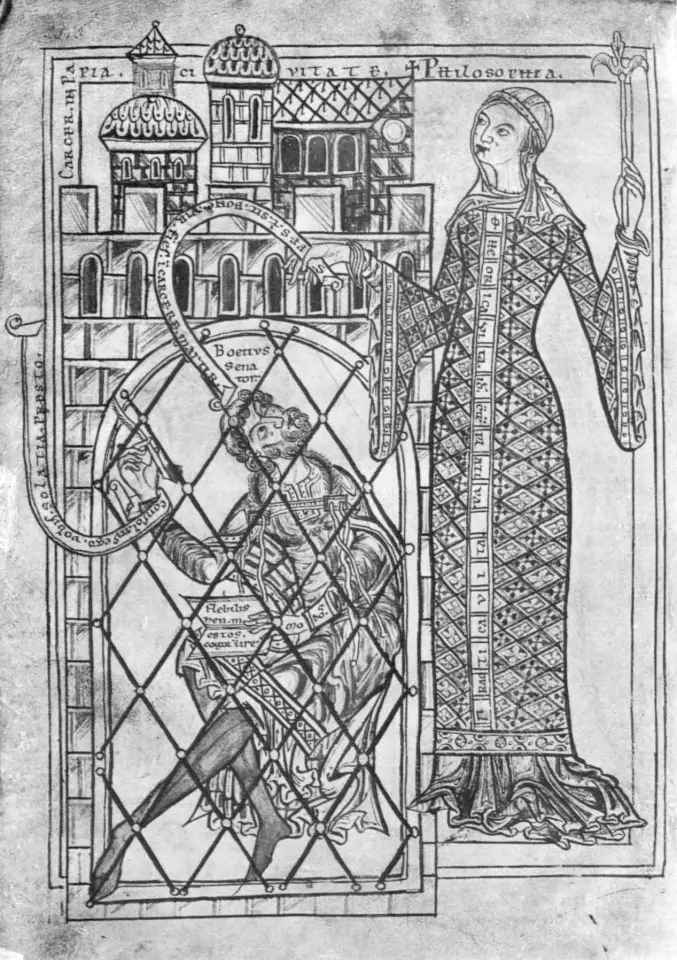
Boethius planned to translate all of Aristotle into Latin with commentaries, then Plato, and to show the agreement of their philosophies, but managed to translate only the logical works; until the 12th–13th century the West knew Aristotle mainly through them. Through Boethius the Middle Ages came to the question of universals – whether generic ideas are real. His discussion of the terms "person," "substance" and "being" influenced the doctrine of the Trinity (in Against Eutyches and Nestorius 3 person is defined as "the individual substance of a rational nature"). In The Consolation of Philosophy, written in prison before his execution, there is nothing specifically Christian, which raises a debate about his Christianity. Pelikan connects the era with Justinian's closing of the school of Athens (529).
Positions
- Realists
- Universals are real
- Nominalists
- Universals are only names; reality lies in individuals
- Lane
- In Boethius Neoplatonism occupies a more central place than Christianity; he and Augustine are "Christianized Neoplatonists," but Boethius's conversion was superficial
Key points
- Lane: "the last of the Romans and the first of the scholastics"
- The harmony of Plato and Aristotle meant interpreting Aristotle from a Platonic standpoint
- Three explanations of the non-Christian Consolation: insincerity, abandonment of Christianity, the genre of a philosophical work
- Pelikan: the victory of theology over philosophy after 529 was "Pyrrhic"
Outcome
Boethius became the channel through which the early Middle Ages knew ancient philosophy, especially logic; the question of universals became one of the main problems of the Middle Ages.
People
- Boethius
- Justinian I
- Plato
- Aristotle
Terms
- universals
- Generic ideas (for example, "cat") whose reality was debated.
Place
Rome; Ostrogothic Italy
Sources disagree
Lane: consulship 510, execution 524/25; González: late 5th – early 6th century; Pelikan: closing of the Athenian school 529, Boethius "close in time."
Sources
Primary sources
- Boethius – Against Eutyches and Nestorius (On the Person and Two Natures of Christ), ch. 3
Textbooks
- Jaroslav Pelikan – The Christian Tradition: A History of the Development of Doctrine, vol. 1 (Russian edition), p. 50–54
- Justo L. González – A History of Christian Thought in One Volume (Abingdon, 2014), p. 187–188
- Tony Lane – Christian Thinkers (Russian edition), p. 94–99
In church history
- Boethius: theological treatises, the "Consolation of Philosophy," and his execution (c. 480 – execution in 524/526)
Data compiled: 2026-11-17