2nd century · 2nd century
The Apologists: The "Monarchy" of God, Transcendence and the Name "He Who Is"
According to Hall, ancient philosophy (Plato, Aristotle, the Stoics) could lead thinkers to some form of monotheism even before Christ, and Philo combined Plato's idea of the beautiful with the God of the patriarchs: God is absolutely transcendent, and the Logos provides the link with the world. Against polytheism and the doctrine of the coeternity of matter, the apologists asserted the transcendence of God and strict monotheism – the "monarchy." Aristides, in the oldest surviving apology, speaks of God in negative terms: without name, without beginning, without end, uncompounded (Apology 1). The apologists pointed to the kinship of Greek thought with Scripture. Exodus 3:14, "I am He Who Is," was understood ontologically – Pelikan speaks of a "metaphysics of Exodus."
Positions
- Plato, Aristotle, the Stoics (according to Hall)
- The true Deity is unchanging; God is an unmoved substance; God is the rational logos and world soul
- Aristides
- Barbarians and Greeks are in error; the Jews approach the truth more than all the nations, yet they too erred from true knowledge; only Christians have found the truth (Apology 2–16)
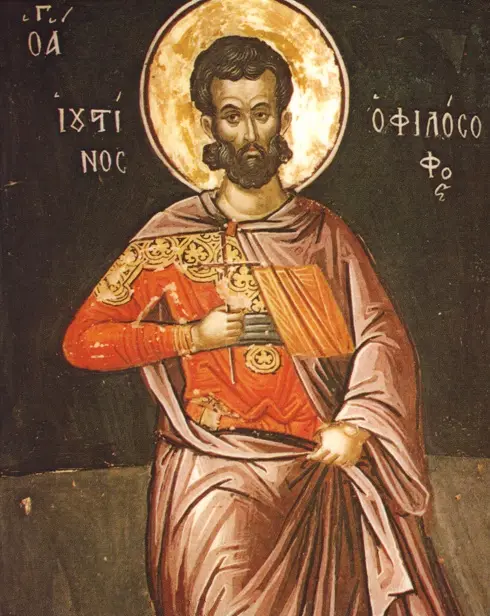
- Justin, Athenagoras, Theophilus
- Socrates was guided by the Logos (Justin, Apology 1.5, 1.46); the Greek poets approach monotheism (Athenagoras, Plea 5); the philosophers borrowed from Moses (Justin, Apology 1.59–60)
Key points
- Hall: Christians were accused of "atheism"; they replied that they renounced false gods in the name of the true God
- Pelikan: the problem became how to reconcile the doctrine of the Trinity and the "economy" in Christ with the monarchy
- Interpretations of Exodus 3:14: Clement, Origen, Hilary, Gregory of Nazianzus; Augustine – grounds for applying "essentia" but not "substantia" to God
- The ontological interpretation entered the compendia of John of Damascus and Thomas
Outcome
An apologetics took shape that combined criticism of paganism with recognition of truth among the philosophers; the doctrine of the transcendent "monarchy" raised the question of its reconciliation with the Trinity.
People
- Aristides
- Justin Martyr
- Athenagoras
- Theophilus of Antioch
- Philo of Alexandria
- Irenaeus of Lyons
Terms
- monarchy
- The absolute sole rule of God, in essence monotheism (originally it meant omnipotence); in Eastern teaching, the single rule of the Father as the source of the Godhead.
- Providence – pronoia
- The one Providence governing the universe, "which orders all things according to appointed times"; most philosophers agreed on its existence.
- logos – λόγος
- The divine reason inherent in God, to which God gave a separate existence; the rational principle of the universe and at the same time the preexistent Christ of the Fourth Gospel. In Philo, the Word created by God before the world, the instrument of creation.
Sources disagree
Hall: the age of the apologists 140–180; González: Aristides under Hadrian (the year is missing from the text); Pelikan: 2nd–3rd centuries for the "monarchy," 2nd–5th centuries for interpretations of Exodus 3:14.
Sources
Primary sources
- Aristides of Athens – Apology, ch. 1–16
- Justin Martyr – First and Second Apology, bk. I, ch. 5, 46, 59–60
- Athenagoras – A Plea for the Christians, ch. 5
Textbooks
- Stuart G. Hall – Doctrine and Practice in the Early Church (Russian edition), p. 8–9, 36–37
- Jaroslav Pelikan – The Christian Tradition: A History of the Development of Doctrine, vol. 1 (Russian edition), p. 45–46, 65–66
- Justo L. González – A History of Christian Thought in One Volume (Abingdon, 2014), p. 21, 42–43
Data compiled: 2026-11-17