1925–1991 · 20th century
The founding of the World Council of Churches and its assemblies
The "Life and Work" movement (Archbishop Nathan Söderblom, Stockholm 1925) and "Faith and Order" (Bishop Charles Brent, Lausanne 1927) agreed at Utrecht in 1938 to merge into a single World Council of Churches. The war delayed its founding by a decade.
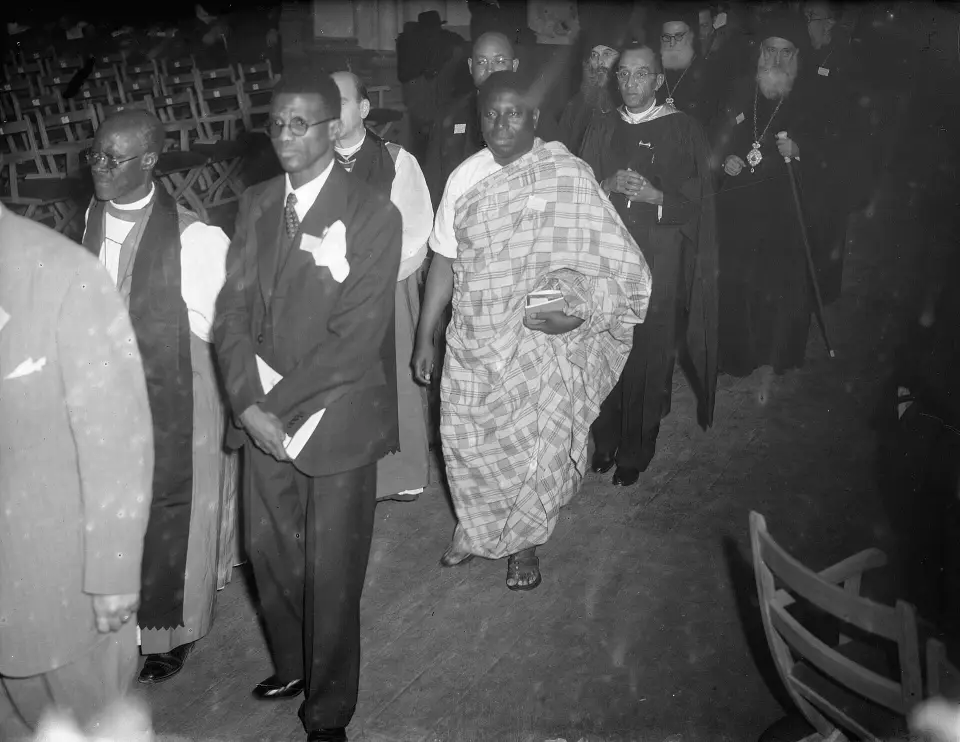
The WCC's first assembly opened on 22 August 1948 in Amsterdam. It brought together 351 delegates from 147 churches in 44 countries. They rejected both communism and liberal capitalism. Many of the movement's leaders were deeply influenced by Karl Barth's theology.
Subsequent assemblies were held at Evanston (1954), New Delhi (1961), Uppsala (1968), Nairobi (1975), and Vancouver (1983). At New Delhi the Orthodox churches joined and the International Missionary Council merged in. The Roman Catholic Church has sent observers since 1961 but has not joined.
Twentieth-century ecumenical dialogue made it impossible to write the history of theology along confessional lines alone.
Key points
- 1938, Utrecht – decision to merge "Faith and Order" and "Life and Work"
- 22 August 1948 – first assembly in Amsterdam (147 churches, 44 countries)
- New Delhi (1961) – Orthodox churches join, merger with the International Missionary Council
- Assemblies at Evanston (1954), Uppsala (1968), Nairobi (1975), Vancouver (1983)
- Roman Catholic observers present from 1961
- Shelley: World War II destroyed thousands of churches and killed priests; the slaughter made many doubt whether a just war was still possible. Christians sought to unite nations and churches – at the UN (1945) and the WCC (1948) – but ‘the bitterness of the nations undid the work’. Earlier the Evangelical Alliance (London, 1846) united fifty English and American bodies and backed religious freedom, but faded by the 1890s; in 1908 thirty-one US denominations formed the Federal Council of Churches, criticised by conservatives – in 1950 the National Council absorbed it. By the 20th century the USA alone had over 200 denominations – Christianity’s centrifugal force; ecumenism became its centripetal force. By 1937 the Faith and Order and Life and Work conferences called for a World Council of Churches, but Hitler and the war delayed it. Visser ’t Hooft (1900–1985), first general secretary, succeeded Mott at YMCA and in 1938 headed the Provisional Committee, the Council’s forerunner; Barth influenced him, and the founders’ slogan was ‘Let the Church be the Church!’ – not flight from the world but refusing to echo its trends. After the war he conceived an Ecumenical Institute in Switzerland, and John D. Rockefeller Jr. gave a million dollars to found the Bossey Institute. At Amsterdam (1948) 351 delegates of 147 denominations from 44 countries met; Catholics, many conservative evangelicals and the Russian Orthodox were absent. At New Delhi (1961) the Russian Orthodox Church joined the Council, the International Missionary Council came under its management, and a new formula (“God and Saviour according to the Scriptures”), jotted by Visser ’t Hooft on a menu, was adopted. The Council makes no laws for the churches; over time doctrine gave way to social issues, and evangelicals criticized it. From 1900 to 1970 the US saw over thirty denominational mergers; the most significant elsewhere was the Church of South India (1947). In 1960 Eugene Carson Blake proposed merging Episcopalians, Presbyterians, Methodists and the United Church of Christ into one Church of 19 million; in Detroit in 1961 the House of Bishops accepted the invitation unanimously in half a minute – Bishop Lichtenberger: ‘I am simply speechless!’ The Consultation on Church Union sought a merger plan, but early enthusiasm faded; twenty years later wording for union was still being sought.
- Larsen: the Evangelical Alliance (1846) was founded partly as a united front against Catholicism; Chalmers hoped for a ‘great anti-Popish Association’.
People
- Nathan Söderblom
- Charles Henry Brent
- Karl Barth
- Josef Hromádka
- Martin Niemöller
- Reinhold Niebuhr
Place
Amsterdam; Evanston; New Delhi; Uppsala; Nairobi; Vancouver
Sources
- J. North – A History of the Church (Russian edition), p. 397–398
- Justo L. González – The Story of Christianity, vol. II (Russian edition), Part 4, ch. 36, section «Поиск единства»
- Justo L. González – A History of Christian Thought, vol. III: From the Protestant Reformation to the Twentieth Century (Abingdon, rev. ed. 1987), p. 450, 485–486
- Justo L. González – A History of Christian Thought in One Volume (Abingdon, 2014), p. 415, 429
- Tony Lane – Christian Thinkers (Russian edition), p. 264, 316–320
- Bruce L. Shelley – Church History in Plain Language (Russian edition), Ch. 42, sec. «Влияние Второй мировой войны»; Ch. 44, introduction; Ch. 44, sec. «Движение жизни и труда»; Ch. 44, sec. «Движение жизни и труда»; «Слияния деноминаций»; Ch. 44, sec. «Движения к христианскому единству»; Ch. 44, sec. «Слияния деноминаций»
- The Cambridge Companion to Evangelical Theology, ed. Timothy Larsen and Daniel J. Treier (2007), p. 21
Data compiled: 2026-11-09