the mid-1st century · 1st century
The missionary journeys and epistles of the apostle Paul
Much of the book of Acts is devoted to Paul's three journeys. The first led through Cyprus into Asia Minor. The second went through Asia Minor, Troas, Macedonia and Greece. The third included a long stay at Ephesus, then again passed through Macedonia and Greece.
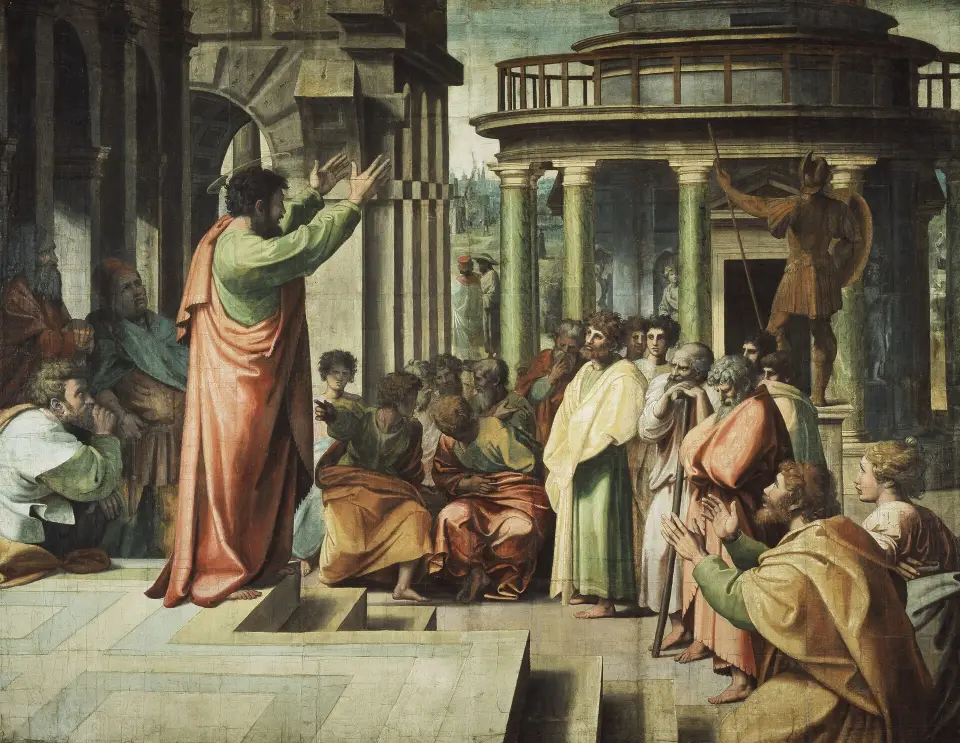
On arriving in a new city, Paul usually went first to the synagogue. He preached not a new religion but the fulfillment of the promises to Israel.
Christianity spread rapidly to Antioch, Ephesus, Athens, Corinth, Rome and possibly Alexandria. By an unconfirmed tradition, it reached Spain as well. Paul, though, was not first everywhere: the church at Rome existed before him. Many obscure Christians, along with Barnabas, Mark and Apollos, spread the faith through the efforts of "non-professional missionaries".
The books regard Paul's chief legacy as his epistles. They became part of Scripture and shaped the theology of the church.
Key points
- First journey – Cyprus and Asia Minor; second – Asia Minor, Troas, Macedonia, Greece; third – Ephesus, then Macedonia and Greece
- In a new city Paul usually went first to the synagogue
- Barnabas, Mark, Apollos and other obscure missionaries preached at the same time
- Paul's epistles shaped the church's theology and became part of Scripture
- Shelley: Paul, a man of three worlds (Jewish, Greek, Roman), could express Jesus’ teaching so that a pagan could understand it. He was arrested in Jerusalem, appealed to Caesar and awaited trial in Rome; by then the break with Judaism was nearly complete.
- Haacker: the anchor date of Paul's career is the proconsul Gallio at Corinth (Acts 18:12–17): a Delphi inscription dates his term to AD 51–2, and his refusal to hear the Jewish charges (Acts 18:14–17) was probably contempt for the Jews rather than tolerance of the Christians. The name Paul was not a result of his conversion but a second, Latin name for a Graeco-Roman public; the apostle's Jewish name was Saul. Paul, a Jew of Tarsus, grew up in Jerusalem from childhood under Gamaliel; there is no evidence that he was preparing to be a teacher of the Torah. After his conversion Paul spent three years at Damascus (with a trip to Arabia), fled a plot and stayed a fortnight with Peter in Jerusalem. The sources are silent on his years at Tarsus: no churches founded in Cilicia are attested before Barnabas called him to Antioch (Acts 11:25–6). Not building on others' foundations (Rom. 15:20) was Paul's preference; at Corinth and Ephesus he split the meetings from the synagogue, and his calling had a universal horizon – to bring the gospel to the whole Roman world, Spain included (Rom. 15:24). The 'war on two fronts' scheme (Lütgert) did not prevail: the only wide threat was the demand that Gentiles be circumcised, which peaked in Galatia. Acts 21–28 on Paul's trial span four or five years; Roman interest in the case presupposes his Roman citizenship.
People
- Paul
- Barnabas
- Mark
- Apollos
- Gamaliel
- Gallio
Place
The eastern Mediterranean; Antioch; Cyprus; Asia Minor; Greece; Rome
Sources disagree
Neither book dates Paul's journeys exactly; the years given are conventional (c. 45–64 AD). Haacker: Paul's visits to Jerusalem are counted from his calling (Gal. 1:18 – after three years, 2:1 – after fourteen); his flight from Damascus fell in the time of King Aretas (ruled 9/8 BC – AD 40/1). The date of Paul's death cannot be fixed; Festus (died AD 62) became governor of Judaea, according to J. B. Green, in AD 59.
Sources
- J. North – A History of the Church (Russian edition), p. 13–14
- Justo L. González – The Story of Christianity, vol. I (Russian edition), Ch. «Благовествование среди язычников», sec. 1.8
- Bruce L. Shelley – Church History in Plain Language (Russian edition), Ch. 2, sec. «Апостол Павел»
- The Cambridge Companion to St Paul, ed. James D. G. Dunn (2003), p. 39, 40, 40–41, 44, 44–45, 47, 48, 49–50, 50, 51
Data compiled: 2026-11-09