1734–1766 · 18th century
The Great Awakening in the British Colonies of North America
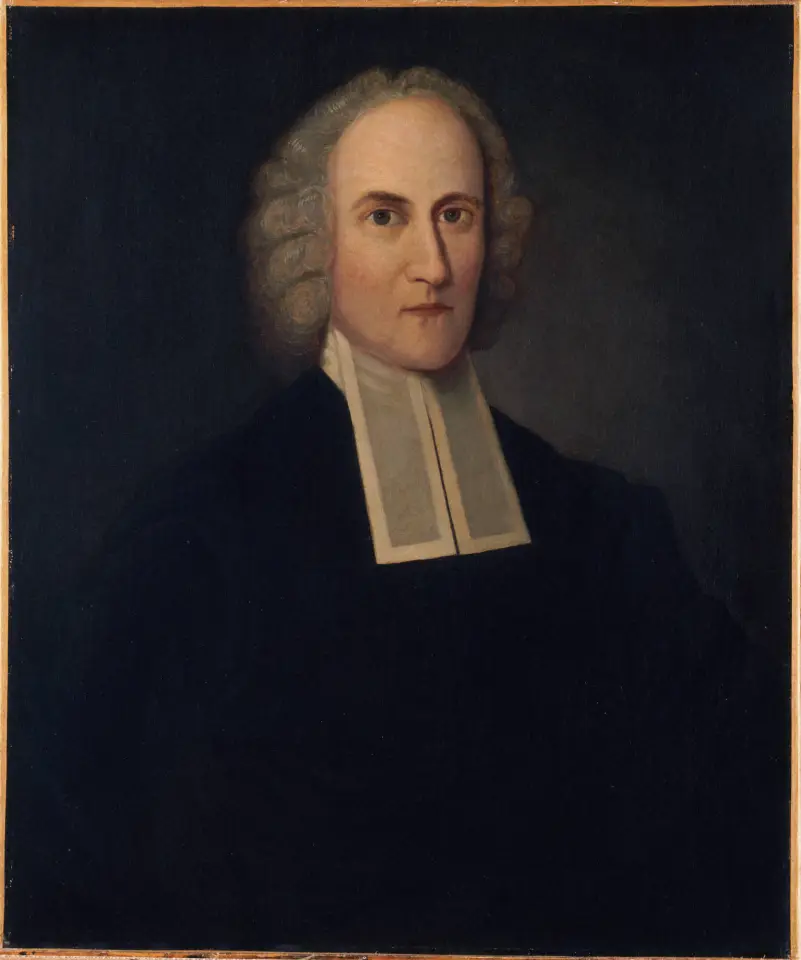
In 1734–1735 a revival began in the parish of the Congregationalist Jonathan Edwards (1703–1758) at Northampton, Massachusetts. Edwards was influenced by Locke's philosophy and believed in unconditional election. In his Treatise Concerning Religious Affections (1746) he sought a balance between critics and exploiters of the revival's religious emotions. In Freedom of the Will (1754) he defended predestination.
From 1740, preaching tours by the Englishman George Whitefield spread the movement across New England and then all thirteen colonies. It cut across denominational lines, and Baptists and Methodists benefited most.
The Awakening fostered a sense of common colonial identity even before the War of Independence. The religious enthusiasm it generated led to the founding of several colleges to train clergy and educated laypeople: Princeton, Columbia, Brown and Rutgers (1746–1766).
Key points
- The revival begins in Jonathan Edwards's Northampton parish (1734–1735)
- Whitefield's preaching tours from 1740 spread it across all thirteen colonies
- Edwards's Religious Affections (1746) and Freedom of the Will (1754)
- Colleges founded (Princeton, Columbia, Brown, Rutgers) in 1746–1766
- Shelley: on the road from London to Oxford Wesley read Edwards’s account of Northampton conversions: “So the Great Awakening in New England revived Wesley”; here is the link between three parts of the evangelical awakening – German pietism, British Methodism and the American Awakening. Whitefield named Frelinghuysen the Awakening’s initiator; Tennent’s Log College trained revivalist preachers. The dispute over “educated” and “converted” clergy split Presbyterians; Shubal Stearns’s Baptists multiplied in Virginia and the Carolinas. At Northampton in December 1734 Edwards saw “the Spirit of God” begin “extraordinarily to set in, and wonderfully to work amongst us” (A Faithful Narrative, pp. 10–11). In 1739–1740 Whitefield preached from Georgia to Boston, uniting the colonies’ revival; even Franklin heard him. At Enfield Edwards preached “sinners in the hands of an angry God”; later generations forgot the theologian and Princeton president in him. By 1741 all elements of revivalism were in place: itinerant preachers, prayer meetings, crowds, disputes and church splits. Isaac Backus was “born from above” in 1741 when the Awakening reached Norwich; he turned Baptist and founded the Middleborough church. From 1740 to 1742 the Awakening touched 25,000–50,000 people, and in 1750–1760 150 new congregations arose
- Weber: Daniel Whitby (England, early 18th century) probably first presented postmillennialism systematically; it caught on only with Jonathan Edwards. In the 1730s a massive, unexpected revival in the colonies (thousands converted, hundreds of new congregations) marked for Edwards a new age: God would use the saints to establish the kingdom worldwide; the millennium comes before the Parousia, though the devil mounts one last revolt. Joseph Bellamy figured the ratio of saved to lost at the millennium’s end would be 17,000 to 1; Samuel Hopkins predicted incredible advances in industry and agriculture. The Second Great Awakening of the early 19th century added fuel to postmillennialism: American Protestantism became evangelical and activist – revivals, schools, churches, publishing houses, missionary societies; Charles G. Finney told converts it was their duty to apply Jesus’ principles to all of life
- Holifield: Edwards lost his Northampton pulpit after trying to bar the children of half-way members from baptism; the sacrament touched the family itself.
- Holmes: in the 18th century British and American evangelical theology scarcely differed; Edwards was its great theologian on both sides of the Atlantic.
- George: Whitefield, a Calvinist, crossed the Atlantic seven times and is said to have preached 15,000 times in 33 years; he quarreled with Wesley over predestination but was reconciled. The roots of Canadian evangelicalism lie in revivals in the Maritimes under the Nova Scotian evangelist Henry Alline. After Edwards’s death Beecher and Taylor modified his synthesis of Calvinism and revivalism, while Hodge and Princeton warned against such devolution; citing Noll, later revivalists followed Edwards in calling for the new birth more often than theologians defended the Calvinist themes central to him.
People
- Jonathan Edwards
- George Whitefield
- Theodore Frelinghuysen
- Gilbert Tennent
- Henry Alline
Place
Northampton (Massachusetts); New England; the thirteen colonies
Sources disagree
The Northampton revival's start is given as 1734 or 1734/35; Edwards's dismissal (1750) and death (1758) fall outside this event's overall range.
Sources
Primary sources
- Edwards – A Faithful Narrative of the Surprising Work of God, p. 10–11
Textbooks
- Justo L. González – A History of Christian Thought, vol. III: From the Protestant Reformation to the Twentieth Century (Abingdon, rev. ed. 1987), p. 323–324
- Justo L. González – A History of Christian Thought in One Volume (Abingdon, 2014), p. 380–381
- J. North – A History of the Church (Russian edition), p. 9–10
- Tony Lane – Christian Thinkers (Russian edition), p. 188–190
- Justo L. González – The Story of Christianity, vol. II (Russian edition), Part 2, ch. 24
- Louis Berkhof – History of Christian Doctrines (Russian edition), p. 114–115, 144
- Bruce L. Shelley – Church History in Plain Language (Russian edition), Ch. 34, sec. «Тепло святого сердца»; Ch. 35, sec. «Воля Божья в обществе»; Ch. 35, sec. «Воля Божья в обществе»; «Великий проповедник»; Ch. 35, sec. «Великий проповедник»; Ch. 35, sec. «Великий проповедник»; «Защитник религиозных свобод»
- The Oxford Handbook of Eschatology, ed. Jerry L. Walls (2008), Ch. 20, sec. «The Modern Period»
- The Oxford Handbook of Sacramental Theology, ed. Hans Boersma, Matthew Levering (2015), p. 459–460
- The Cambridge Companion to Evangelical Theology, ed. Timothy Larsen and Daniel J. Treier (2007), p. 257, 290
More on the doctrine
Data compiled: 2026-11-09