476 · 5th century
The fall of the Western Roman Empire
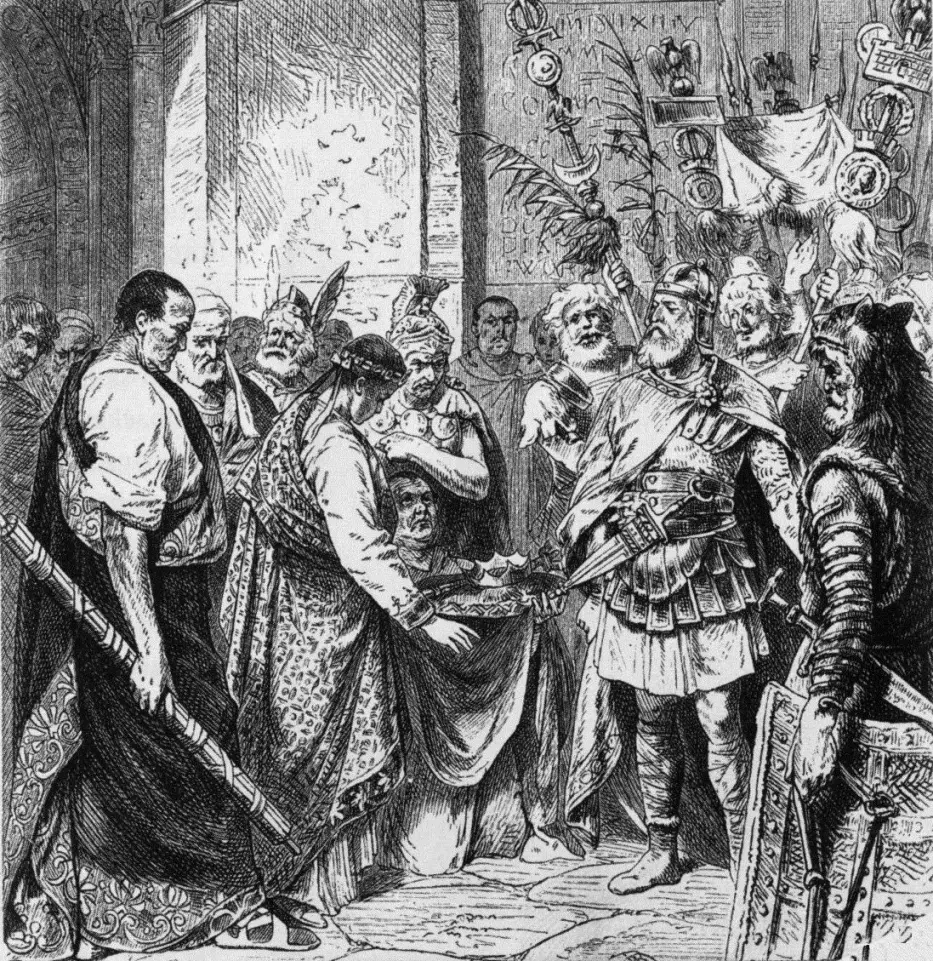
In 476 the Germanic leader Odoacer deposed the last Western emperor, the young Romulus Augustulus. He sent the imperial regalia to Emperor Zeno in Constantinople, declaring the empire reunited.
By this time the western provinces had already effectively become Germanic kingdoms. The event is traditionally regarded as the end of the Roman Empire in the West and the beginning of the "Dark Ages." In that period monasteries remained almost the only islands of learning and stability. Zeno later invited the Ostrogoths to conquer Italy, which remained nominally part of the Eastern Empire.
Key points
- Odoacer deposes Romulus Augustulus and sends the regalia to Constantinople
- The western provinces had already become Germanic kingdoms by this time
- Traditional date for the end of the Western Roman Empire and start of the "Dark Ages"
- Monasteries remain centers of learning and stability
- Shelley: the fall in 476 was almost unnoticed: real power lay with mostly German mercenaries, “some Germans were killing other Germans”. In 475 Orestes made his small son Romulus Augustulus emperor; in 476 Odoacer killed him and deposed Romulus; “nobody was particularly astonished”. By the end of the fourth century the Roman army in the West was almost wholly “Germanized”. The Huns subdued the Ostrogoths; the Visigoths, admitted across the Danube in 376 but ill-treated by officials, defeated Valens at Adrianople (378). In 406–407 the Romans withdrew troops from the Rhine and Britain, and the Germans poured into the empire. Yet the invasions were less catastrophic than they seemed: the Germans stayed a minority, mingled with the Romans and lost their language, hence there is hardly a trace of Germanic languages in Italy, France and Spain; only the Franks in Gaul and the Angles and Saxons in Britain held their kingdoms for long. Romans called Germans “barbarians” because they spoke neither Greek nor Latin; in the 3rd c. they moved to settled farming. Tacitus praised Germanic courage; warriors were bound by oath to their chief, and the gods’ names survive in the weekdays
People
- Odoacer
- Romulus Augustulus
- Zeno
Place
Rome, Italy
Sources
- Tony Lane – Christian Thinkers (Russian edition), p. 89–90
- Justo L. González – The Story of Christianity, vol. I (Russian edition), Ch. 20, sec. 20.1, 20.3
- J. North – A History of the Church (Russian edition), p. 99
- Bruce L. Shelley – Church History in Plain Language (Russian edition), Ch. 16, sec. «Пришествие варваров»
Data compiled: 2026-11-09