1910–1937 · 20th century
The 1910 Edinburgh Missionary Conference and the birth of the ecumenical movement
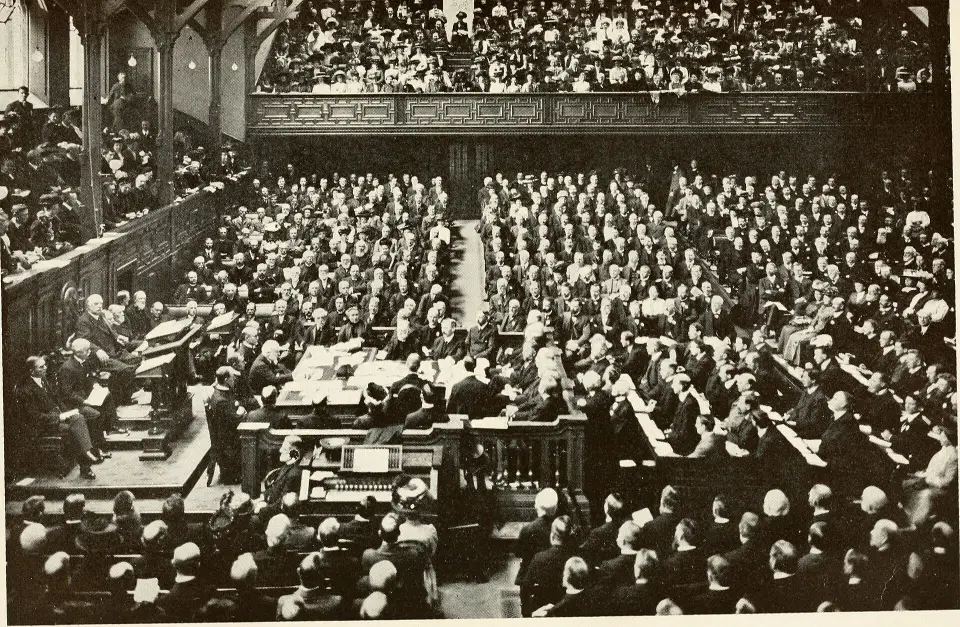
The 1910 World Missionary Conference in Edinburgh was led by the Methodist John Mott. For the first time it gathered over 1,200 official delegates from Protestant missionary societies of different denominations. Questions of "faith and order" and mission among Catholics and Orthodox were deliberately excluded.
The conference is traditionally regarded as the birth of the ecumenical movement. It gave rise to the International Missionary Council (1921) and to two movements. "Faith and Order" dealt with doctrinal unity and held conferences at Lausanne (1927) and Edinburgh (1937). "Life and Work," led by Nathan Söderblom, dealt with social questions; it met in Stockholm (1925) and Oxford (1937).
In 1937 both movements resolved to create a single World Council of Churches.
Key points
- Edinburgh, 1910 – over 1,200 delegates from 160 missionary organizations led by John Mott
- International Missionary Council (1921) – coordinating missions in China, India, Japan, the Congo
- "Faith and Order" (Lausanne 1927, Edinburgh 1937) and "Life and Work" (Stockholm 1925, Oxford 1937)
- 1937 – decision to merge both movements into a single World Council of Churches
- Shelley: the 1910 Edinburgh conference gathered over a thousand delegates on world missions, and they proved largely united. Three tributaries of the World Council descend from Edinburgh: the International Missionary Council, Life and Work, and Faith and Order. Early leaders of the movement included John Mott, Charles Brent, Nathan Söderblom and Visser ’t Hooft. Mott, a Methodist layman, combined deep faith, zeal for evangelistic preaching and eloquence; he became Y.M.C.A. student secretary at 23, founded the World Student Christian Federation and chaired Edinburgh. He chaired the “Continuation Committee” and from 1921 was first chairman of the International Missionary Council for twenty years; no leader of the Council did as much as Mott for the spread of Christianity. Charles Brent (1862–1929), a Canadian Anglican and ex-missionary in the Philippines, knew better than Mott the doctrinal differences of the Churches and saw in Anglicanism a bridge able to connect them. Edinburgh approved efforts to resolve conflicts of missionary societies, and Brent reported this to the Anglican convention in Chicago; at his insistence a committee invited “all Churches which accept Jesus Christ as God and Saviour” to conferences “for the consideration of all questions pertaining to the Faith and Order of the Church of Christ”. Because of the First World War the first World Conference on Faith and Order met only in August 1927 at Lausanne; 150 representatives of 69 denominations adopted resolutions that laid the foundation for the future Council. Brent held cooperation possible only if the foundations of faith are agreed: division is about creeds, and until resolved there is no unity. The Lutheran Nathan Söderblom (1866–1931), Archbishop of Uppsala, founded and chiefly promoted the Life and Work Movement; when in 1914 the King of Sweden unexpectedly appointed him archbishop, conservatives doubted his orthodoxy. Söderblom rejected belief in Christ’s divine and human nature as unacceptable to modern man, saw revelation as a continuous process and religion as what man is and does, not what he believes. Söderblom sought unity not in doctrinal agreements like Brent but in history: each group respects the others and shares its differences. At Stockholm (August 1925) 500 delegates from 39 countries and 91 denominations decided the Church must accept responsibility for the common good
- Padilla: Edinburgh 1910 admitted no Latin American representatives and excluded the region as ‘missionary territory’: it was a Catholic continent. The Committee on Cooperation in Latin America was founded at the first Latin American Evangelical Congress in Panama (1916). In The Other Spanish Christ (1933) J. Mackay set the Christ of popular religion against ‘the other’ Christ of Lull, the mystics and the Reformation.
People
- John Mott
- William Carey
- Charles Henry Brent
- Nathan Söderblom
- William Temple
- John A. Mackay
Place
Edinburgh; Lausanne; Stockholm; Oxford
Sources
- Justo L. González – The Story of Christianity, vol. II (Russian edition), Part 3, ch. 30, section «Экуменическое движение»; Part 4, ch. 36, section «Поиск единства»
- J. North – A History of the Church (Russian edition), p. 393–395
- Tony Lane – Christian Thinkers (Russian edition), p. 316
- Bruce L. Shelley – Church History in Plain Language (Russian edition), Ch. 44, sec. «Движения к христианскому единству»; Ch. 44, sec. «Движение жизни и труда»
- The Cambridge Companion to Evangelical Theology, ed. Timothy Larsen and Daniel J. Treier (2007), p. 272, 275, 274–275, 274
Data compiled: 2026-11-09