13th century (condemnation – 1270) · 12th century
The Arrival of Aristotle in the West: Universities, Three Thirteenth-Century Responses and the Condemnation of the Averroists (1270)
Translations in Toledo and direct translations from the Greek flooded Latin Europe with the writings of Aristotle and the Arabic philosophers, above all Averroes ("the Commentator"); according to González, the whole edifice of medieval theology was shaken. Lane writes that philosophy came to seem a rival system of thought; Aristotle's metaphysics was banned for a time. González distinguishes three responses: the traditional Augustinian framework (Bonaventure), synthesis (Albert and Thomas) and the demand for philosophy's independence from orthodoxy (Siger of Brabant). In 1270 the bishop of Paris condemned thirteen theses of extreme Aristotelianism. At the same time the structure of the scholastic method became fixed in the universities.
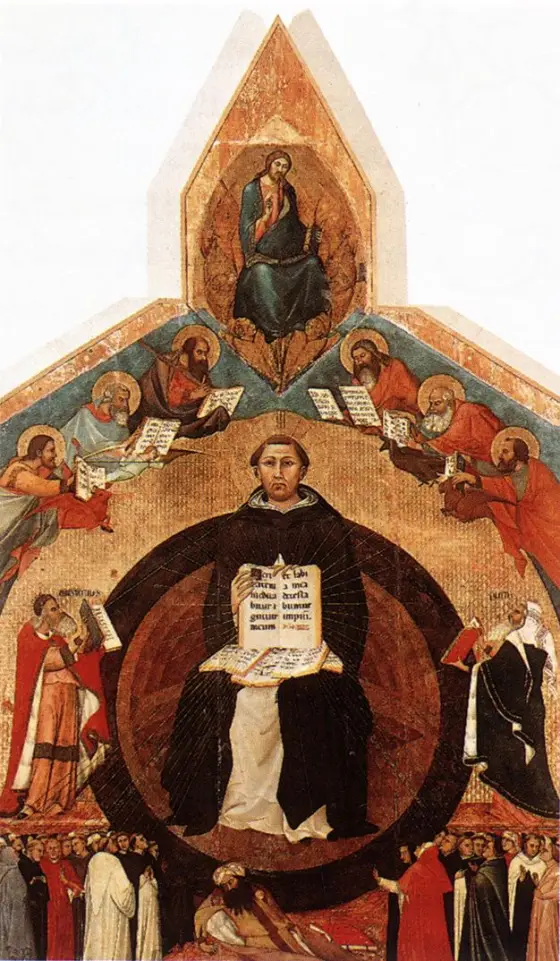
Positions
- Bonaventure and the Augustinians
- The traditional framework with Aristotelian elements; all knowledge is divine illumination, God's existence is implied in the very idea of God
- Albert the Great, Thomas Aquinas
- A synthesis of Aristotle and Augustinianism
- Siger of Brabant and the "Latin Averroists"
- The eternity of the world, the unity of the intellect, the independence of philosophy from theology ("double truth")
Key points
- Averroes supported Aristotelian empiricism against the Augustinian doctrine of illumination
- The scholastic treatise: question, arguments, solution, refutation of objections – an echo of Sic et Non
- The name "Averroists" came from Thomas's treatise On the Unity of the Intellect (1270; ch. 1, par. 17: "the Averroists" wish to take Aristotle to mean that the intellect is not the soul which is the act of the body)
- The condemned theses: the eternity of the world, denial of providence, the unity of the agent intellect, determinism
- Shelley: in the 13th century Aristotle's lost works, preserved by Eastern Christians and Muslims, reappeared in Western universities. Most theologians, including Origen and Augustine, relied on Platonic dualism: perfect ideas and imperfect copies; Aristotle held that forms are present in concrete things, so truth is sought by studying the sensible creation. Many knew Aristotle via Averroes, in whom reason could lead to conclusions contradicting revelation (eternity of matter). Thomas insisted common sense never leads away from God's truth: revelation surpasses reason but does not contradict it, and “all truth is God's”
Outcome
The condemnation did not stop the debates: at the University of Paris they continued at least until 1328, in Padua until the 17th century.
People
- Averroes
- Raymond of Toledo
- Bonaventure
- Albert the Great
- Thomas Aquinas
- Siger of Brabant
Terms
- double truth
- The independence of philosophy and theology in the search for truth.
Place
Toledo; Paris; Oxford
Sources disagree
González: the Toledo translations – 12th century, Averroes – 1126–1198, Bonaventure's treatises against Aristotelian theses – from 1267, the condemnation – 1270; Lane: 13th century.
Sources
Primary sources
- Thomas Aquinas – On the Unity of the Intellect against the Averroists, ch. 1, para. 17
Textbooks
- Justo L. González – A History of Christian Thought in One Volume (Abingdon, 2014), p. 226–227, 245–247, 249–251, 257–258
- Tony Lane – Christian Thinkers (Russian edition), p. 90
- Bruce L. Shelley – Church History in Plain Language (Russian edition), Ch. 20, sec. «Поддержка папской монархии»
Related entries
- Answered by: Thomas Aquinas: The Synthesis of Reason and Revelation, the Summa contra Gentiles and the Summa Theologiae (1260–1274)
Data compiled: 2026-11-17